In September 2021, Squid Game exploded from a Korean streaming series into a worldwide cultural event. Created by Hwang Dong-hyuk, this dystopian survival drama tapped into universal anxieties about debt, inequality, and human desperation, becoming Netflix’s most-watched series ever within its first month. More than just entertainment, it became a lens through which global audiences examined capitalism, human morality, and societal pressures.
Series Overview
Title: Squid Game (오징어 게임)
Creator: Hwang Dong-hyuk
Episodes: 9
Genre: Survival thriller, Social commentary, Horror-drama
Original Network: Netflix
Release Date: September 17, 2021
Starring: Lee Jung-jae, Park Hae-soo, Wi Ha-joon, Jung Ho-yeon, O Yeong-su, Heo Sung-tae, Anupam Tripathi
Plot Summary: Desperation Meets Deadly Childhood Games
The Premise:
456 deeply indebted individuals—mostly marginalized by society—receive a mysterious invitation to compete in a series of games for a ₩45.6 billion prize (approximately $38 million USD). The catch: the games are deadly versions of Korean childhood games, and losing means death.
Main Characters:
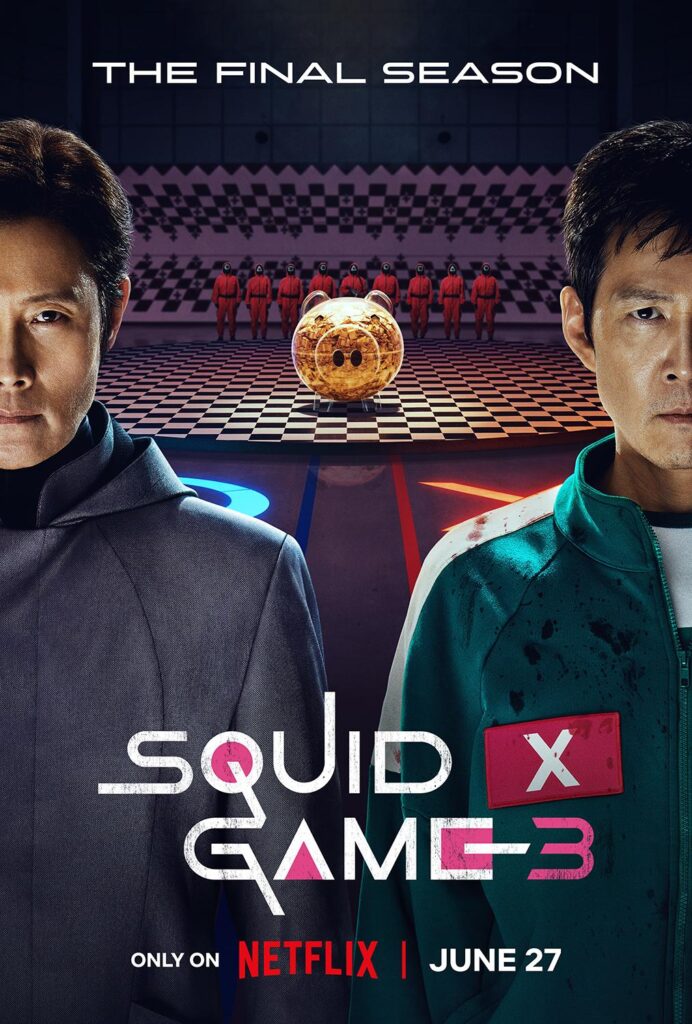
Seong Gi-hun (Player 456) – Lee Jung-jae
- A divorced chauffeur drowning in gambling debt and struggling to maintain relationships with his ex-wife and daughter
- Represents the “everyman” corrupted by systemic failures
- His number, 456, indicates he’s the last to join and becomes the narrative center
Cho Sang-woo (Player 218) – Park Hae-soo
- Gi-hun’s childhood friend and Seoul National University graduate
- A disgraced investment manager who embezzled clients’ money
- Embodies educated privilege turned toxic under pressure
Kang Sae-byeok (Player 067) – Jung Ho-yeon (in her acting debut)
- A North Korean defector trying to reunite her family
- Calculating, resourceful, and motivated by familial love rather than greed
- Became a global fan favorite and symbol of resilience
Abdul Ali (Player 199) – Anupam Tripathi
- A Pakistani migrant worker whose employer withheld his pay
- Represents the invisible immigrant labor force
- His kindness and faith contrast with the game’s brutality
Oh Il-nam (Player 001) – O Yeong-su
- An elderly man with a brain tumor who wants to “feel alive” before dying
- His character holds the series’ biggest twist
Hwang Jun-ho – Wi Ha-joon
- A police officer who infiltrates the games searching for his missing brother
- Provides the audience’s investigative perspective
The Front Man – Lee Byung-hun (revealed later)
- The mysterious overseer of the games with his own tragic connection
The Games: Deadly Simplicity
1. Red Light, Green Light (무궁화 꽃이 피었습니다)
- Rules: Cross the finish line during “green light,” freeze completely during “red light”
- Twist: The “doll” is a motion-detecting machine gun
- Significance: Immediate establishment of stakes; mass elimination (255 deaths) shows the game’s scale and ruthlessness
2. Honeycomb (달고나)
- Rules: Extract one of four shapes (umbrella, star, circle, triangle) from honeycomb without breaking it
- Twist: Players unknowingly choose their difficulty level; the umbrella shape is nearly impossible
- Significance: Highlights how systems can be rigged from the start; ingenuity and observation are rewarded
3. Tug of War (줄다리기)
- Rules: Standard tug of war, but losing team falls to their death
- Twist: Strategy and teamwork outweigh brute strength
- Significance: First game requiring cooperation, yet still ending in mass death
4. Marbles (구슬치기)
- Rules: Play whatever marble game you choose with a partner; win all your partner’s marbles
- Twist: Players must compete against their chosen ally
- Significance: Psychological breaking point; forces betrayal of bonds formed under duress
5. Glass Stepping Stones (징검다리)
- Rules: Cross a bridge of tempered and regular glass panels; regular glass breaks under weight
- Twist: The glass is nearly indistinguishable; pure chance determines survival
- Significance: Emphasizes the role of luck in survival; the wealthy VIPs watch this as entertainment
6. Squid Game (오징어 게임)
- Rules: Final one-on-one physical confrontation based on the actual Korean children’s game
- Twist: No special rules—just brutal, personal combat
- Significance: Returns to the series’ namesake; ultimate test of will and morality
Ending Explained: Ambiguity and Aftermath
The Final Game & Twist
After Sang-woo fatally stabs Sae-byeok, only Gi-hun and Sang-woo remain. Their final confrontation in Squid Game ends when Sang-woo, realizing his moral bankruptcy, impales himself on a shard of glass, allowing Gi-hun to win.
Before dying, Sang-woo asks Gi-hun to care for his mother—a moment of redemption that contrasts with his earlier betrayals.
The Il-nam Revelation
One year later, Gi-hun discovers the dying Il-nam in a hospital. The shocking reveal: Il-nam was the original founder of the games. His explanation:
- The games were created by bored, ultra-wealthy individuals (“VIPs”) who believe economic inequality is natural
- They see the games as “fair” because everyone has equal opportunity to compete
- Il-nam’s final bet with Gi-hun (whether someone would help a homeless man in the cold) proves humanity retains goodness even in harsh conditions
- Il-nam dies, leaving Gi-hun with the realization that the games continue
Gi-hun’s Transformation & The Final Scene
Despite winning, Gi-hun is psychologically destroyed. He:
- Doesn’t touch his winnings for a year
- Neglects his daughter again
- Lives with trauma and guilt
After meeting Il-nam, he:
- Dyes his hair bright red (symbolizing anger, revolution, or warning)
- Books a flight to Los Angeles to reunite with his daughter
The Final Moment: At the airport, Gi-hun sees the same recruiter who first recruited him, now approaching a new potential player. He calls the number on the recruiter’s card and demands to speak to the games’ organizers, declaring he “can’t forgive” what they’ve done. He turns away from his flight, suggesting he will attempt to dismantle the games from within.
Symbolism of the Ending
- Red hair: Rejection of conformity; visible rage; a “scarlet letter” of his experience
- Turning back: Choosing systemic change over personal happiness
- The continuing recruiter: The cycle of exploitation persists
- “I can’t forgive”: Transition from passive victim to active resister
The VIPs & Global Commentary
The wealthy international spectators represent global capital’s detachment from human suffering. Their:
- Animal masks (ox, deer, eagle, etc.) symbolize their beastly nature
- Poor English dialogue critiques how Western audiences might consume others’ suffering as entertainment
- Sexual exploitation of guards highlights additional layers of abuse
- Commentary explicitly states their belief that inequality is natural and the games provide “fair” competition
Themes & Social Commentary
1. Modern Debt Slavery
The players’ debts—from gambling, business failures, medical bills, migration exploitation—mirror real-world predatory lending and economic traps. The games offer “freedom” through even more extreme exploitation.
2. The Myth of Meritocracy
Despite the games’ appearance of equal opportunity, advantages persist:
- Physical strength helps in tug of war
- Intelligence aids in honeycomb game
- Wealthy VIPs manipulate outcomes for entertainment
- Ultimate message: Systems claiming to be fair often reinforce existing inequalities
3. Human Nature Under Capitalism
The series explores whether cooperation or competition is more “natural”:
- Early episodes show temporary cooperation
- Marbles episode forces betrayal of cooperation
- Sang-woo represents how education and privilege can corrupt
- Ali and Sae-byeok maintain humanity despite circumstances
4. Childhood Nostalgia Corrupted
By using children’s games, Hwang critiques how innocence is sacrificed for survival in adulthood. The colorful, playground-like aesthetics contrast violently with the bloodshed.
5. Korean Specificity & Global Resonance
While rooted in Korea’s:
- IMF crisis aftermath
- Rapid economic polarization
- Specific childhood games
- Migrant worker issues
It resonates globally due to universal experiences of economic anxiety.
Critical Review
Strengths:
1. Pacing & Structure
Each episode ends with a cliffhanger, while the game-per-episode structure provides clear narrative milestones. The 9-episode length feels complete without padding.
2. Production Design
The surreal aesthetic—pastel colors, geometric shapes, giant playground structures—creates unforgettable imagery that contrasts with the violence.
3. Character Development
Even minor players receive emotional backstories, making deaths impactful rather than gratuitous. The main quartet represents different responses to desperation.
4. Social Commentary Integration
Themes emerge naturally from plot rather than feeling didactic. The critique works on both Korean and global levels.
5. Performances
- Lee Jung-jae carries the emotional weight from everyman to broken survivor
- Jung Ho-yeon’s debut is astonishing in its subtlety and strength
- O Yeong-su’s gentle delivery makes his final reveal devastating
- Park Hae-soo masterfully portrays intellectual arrogance crumbling
Weaknesses:
1. VIP Dialogue
The stilted English conversations feel cartoonish compared to the nuanced Korean dialogue, though this may be intentional commentary on Western caricatures.
2. Police Subplot Resolution
Jun-ho’s investigation builds tension but ends somewhat abruptly, though it sets up potential second season material.
3. Some Logical Gaps
Medical oversight, recruitment scale, and logistical questions persist for scrutinizing viewers.
4. Violence Debates
Some critics argue the violence becomes numbing or exploitative, though supporters see it as necessary for the critique.
Cultural Impact & Legacy
Record-Breaking Success
- Most-watched Netflix series ever (1.65 billion hours in first 28 days)
- Topped charts in 94 countries
- Inspired countless memes, Halloween costumes, and TikTok challenges
- Increased global interest in Korean language and culture
Real-World Parallels & Discussions
- Sparked debates about debt, inequality, and universal basic income
- Korean politicians referenced it in policy discussions
- Schools used it to teach about economic theory and ethics
- Actual “Squid Game” survival competitions emerged (without deaths)
Merchandise & Spin-offs
- Video game adaptations announced
- Reality competition series Squid Game: The Challenge (2023)
- Planned video game from Netflix
- Endless merchandise, though ironic given the series’ anti-consumerist themes
Season 2 & Beyond: What’s Next
Confirmed for 2024 release:
- Return of Gi-hun and the Front Man
- Introduction of new characters
- Likely exploration of the games’ global expansion
- Potential focus on Gi-hun’s attempted takedown
Theories:
- The Recruiter (Gong Yoo) may have a larger role
- Potential exploration of other countries’ versions
- Jun-ho may have survived his cliffhanger
- Deeper dive into the VIP network
Where to Watch & Content Warnings
Platform: Netflix worldwide
Original Language: Korean (highly recommended over dubbing)
Subtitles: Multiple languages available
Content Warnings:
- Graphic violence and bloodshed
- Psychological trauma and suicide
- Intense scenes of death and dying
- Themes of exploitation and dehumanization
- Moderate sexual content
Not suitable for children or sensitive viewers.
Similar Series Recommendations
Korean:
- Sweet Home (2020) – Apocalyptic horror with social commentary
- Kingdom (2019) – Zombie historical drama with class critique
- Hellbound (2021) – Supernatural thriller about belief and judgment
- D.P. (2021) – Military drama about systemic abuse
International:
- Alice in Borderland (Japan, 2020) – Similar deadly game premise
- 3% (Brazil, 2016) – Dystopian competition for elite status
- Black Mirror (UK, 2011) – Anthology about technology and morality
- Battle Royale (Japan, 2000 film) – The original deadly competition story
Final Verdict
Rating: ⭐⭐⭐⭐⭐ (5/5)
Squid Game is more than a television series—it’s a cultural landmark that captured global anxiety at a precise historical moment. Its genius lies in balancing crowd-pleasing thriller elements with sharp social criticism, wrapped in unforgettable visual storytelling.
While not without flaws, its impact on streaming media, international content consumption, and public discourse about inequality is undeniable. It proves that genre entertainment can be both massively popular and intellectually substantial.
The ending’s ambiguity perfectly reflects our ongoing struggle with systemic injustice: no easy answers, but the choice to continue fighting matters. Gi-hun’s red hair and turned back give us not closure, but challenge—a fitting conclusion for a series about the games capitalism plays with human lives.
Essential viewing for anyone interested in modern television, social critique, or understanding the global appetite for stories about economic survival. A masterpiece that will be studied and referenced for years to come.