Released in 2008, The Dark Knight isn’t just a superhero film; it is a sprawling crime saga that redefined what blockbuster cinema could achieve. Directed by Christopher Nolan, it elevated the caped crusader into the realm of complex psychological drama and sociopolitical commentary, famously becoming the first comic book movie to be taken seriously as a contender for major awards.
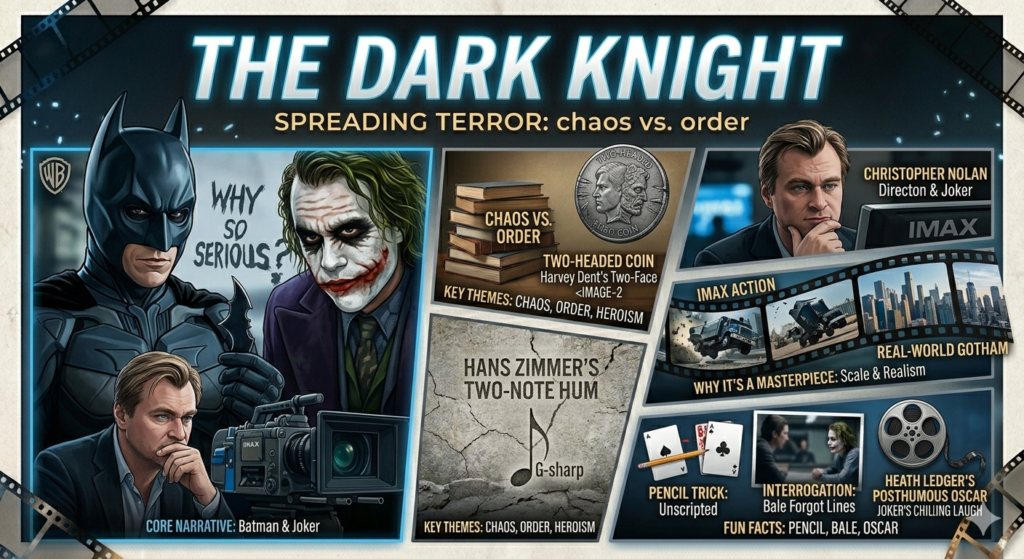
The Dark Knight. The vertical composite is designed like a textured comic book mosaic and includes the following panels:
- Row 1 (Core Narrative): A powerful close-up of Batman (Christian Bale) in his cowl, contrasted with a menacing Heath Ledger as the Joker.
- Row 2 (Key Themes): Symbolic imagery of “Chaos vs. Order” with stacks of books and a single two-headed silver coin, one side scarred (referencing image_6.png and image_2.png). It also includes a sound wave graphic representing Hans Zimmer’s two-note Joker motif from image_0.png.
- Row 3 (Masterpiece): Dedicated to the groundbreaking filmmaking of Christopher Nolan. It shows dynamic panels representing the visceral IMAX action and the grounded “Real World” Gotham (Chicago cityscape).
- Row 4 (Fun Facts): A mosaic of memorable fun facts, including a small pencil disappearing into a card trick, a blurry still of the intense interrogation scene, and a graphic celebrating Heath Ledger’s posthumous Academy Award for his performance as the Joker.
The Core Narrative
Set about a year after Batman Begins, the film finds Batman/Bruce Wayne (Christian Bale) making significant progress in his war on Gotham’s organized crime. With the help of idealistic District Attorney Harvey Dent (Aaron Eckhart) and Lt. Jim Gordon (Gary Oldman), the “good guys” have the mob on the ropes.
Their success, however, is short-lived. A new chaotic force emerges: the Joker (Heath Ledger), a psychopathic anarchist who has no motive beyond spreading terror. The film isn’t a simple “good vs. evil” plot; it is a high-stakes psychological chess match. The Joker seeks to break Batman’s one rule (no killing) and prove that even Gotham’s “White Knight” (Dent) can be corrupted, forcing the hero and the city to confront their deepest fears.
Key Themes & Symbolism
Christopher Nolan crafted a dense narrative that uses traditional superhero elements to explore profound ideas:
- Chaos vs. Order: The Joker is “chaos personified.” He acts as the ultimate counter-weight to Batman’s methodical “order.” He has no plans or desires; he is simply the “agent of chaos” that highlights the fragility of civilization.
- The “Grey” Area of Heroism: The film asks hard questions: How far can a hero go before they become the villain? Batman’s extensive surveillance network, designed to find the Joker, forces a modern discussion about security vs. privacy.
- Symbolism of the Coin: Harvey Dent’s two-headed coin (one side pristine, one scarred) symbolizes the duality of human nature. When the coin is scarred by the same explosion that scars Harvey, it signifies his descent from the idealistic “White Knight” into the tragic “Two-Face.”
Why It Remains a Masterpiece
The film’s lasting impact can be attributed to several factors:
- Heath Ledger’s Performance: His portrayal of the Joker is legendary. Ledger’s unpredictable energy, distinct voice, and chilling laugh transformed the villain from a cartoon into a terrifying, iconic force of nature. His posthumous Academy Award was an earned tribute.
- IMAX Cinematography: Wally Pfister utilized IMAX cameras for crucial action sequences, a groundbreaking decision at the time. This massive scale made Gotham feel visceral and immense.
- Hans Zimmer’s Score: The score is defined by a two-note recurring motif for the Joker, which is essentially just a sharp, single, prolonged hum. This unsettling sound creates an immediate sense of unease whenever the villain is present.
- A “Real World” Gotham: Nolan grounded the film in a gritty, realistic version of Chicago, removing much of the gothic architecture associated with previous Batman films. This made the chaos feel dangerously close to home.
Fun Facts You Might Not Know
- The Interrogation Scene: The first take of the Joker’s interrogation by Batman was actually so intense that Christian Bale legitimately “forgot” his lines. Christian Bale and Heath Ledger had a great respect for each other, Bale recalled: “He knew exactly what he was doing… he wanted to create something very serious.”
- The Pencil Trick: This gory, unscripted moment (Joker: “I’m gonna make this pencil disappear… TA-DA!”) required Heath Ledger to improvise. The pencil was actually attached to his arm via a simple trick, but the moment still required careful timing to avoid real injury.
- No Origin Story: Nolan made a deliberate choice to provide no backstory for the Joker. This makes him terrifying because his motivations are truly inscrutable—he just “wants to watch the world burn.”
“You either die a hero, or you live long enough to see yourself become the villain.” — Harvey Dent