Released in 1994, The Shawshank Redemption is a masterclass in cinematic storytelling that proves “hope is a good thing, maybe the best of things.” Despite a lukewarm initial box office performance, it has since become one of the most beloved films in history, famously holding the #1 spot on the IMDb Top 250 for years.
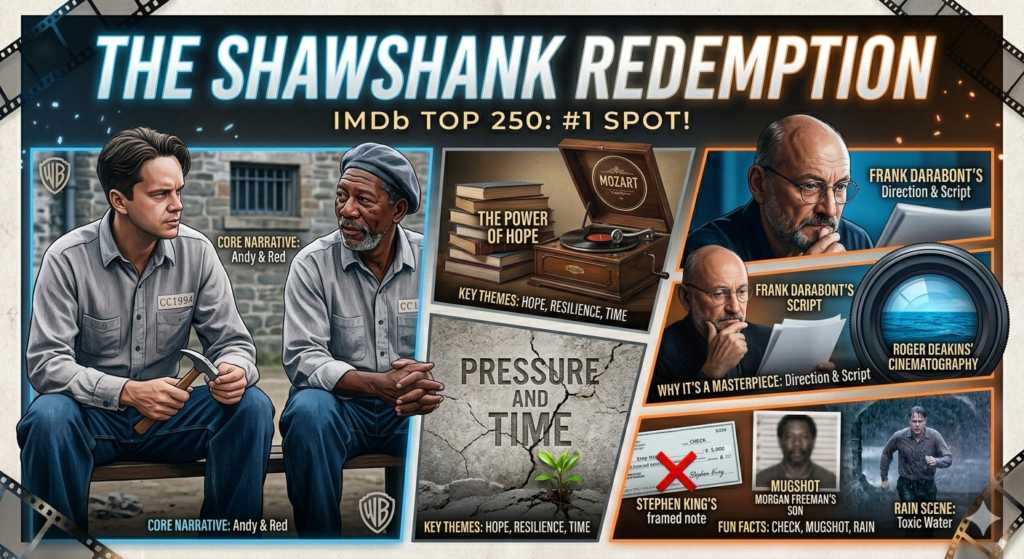
The Shawshank Redemption. It’s designed like a vintage film strip and mosaic, capturing the key elements of the movie from your article:
- Top (Main Title): Large, glowing text highlighting The Shawshank Redemption and its status as the #1 spot on the IMDb Top 250.
- Row 1 (Core Narrative): A powerful close-up of Tim Robbins as Andy and Morgan Freeman as Red, sitting together in the prison yard.
- Row 2 (Key Themes): Symbolic imagery representing “Hope, Resilience, and Time” with stacks of books and an old gramophone for the “Mozart” scene. A small plant sprouts from cracked stone, referencing the “pressure and time” metaphor from image_6.png.
- Row 3 (Masterpiece): Dedicated to the filmmaking craft, showing Frank Darabont’s screenplay and a camera lens representing Roger Deakins’ cinematography reflecting the “blue promise” of the ocean.
- Row 4 (Fun Facts): A mosaic of fun facts including a framed $5,000 check sent back by Stephen King, Alfonso Freeman’s mugshot as a young Red, and a wet Tim Robbins in the toxic “Rain Scene.”
The Core Narrative
Based on the Stephen King novella Rita Hayworth and Shawshank Redemption, the film follows Andy Dufresne (Tim Robbins), a banker who is sentenced to life in Shawshank State Penitentiary for the murder of his wife and her lover—a crime he maintains he did not commit.
While Andy’s internal journey is the heart of the film, it is narrated by Ellis “Red” Redding (Morgan Freeman), the prison “entrepreneur” who can get you anything from a pack of cigarettes to a rock hammer. Their burgeoning friendship over two decades becomes the ultimate vessel for the film’s themes of resilience, friendship, and the indomitability of the human spirit.
Key Themes & Symbolism
The film uses the claustrophobic setting of the prison to explore deep philosophical ideas:
- Institutionalization: Best represented by the tragic character of Brooks Hatlen, the film explores how a person can become so accustomed to “life inside” that the freedom of the outside world becomes a death sentence.
- The Power of Hope: Andy’s refusal to let the prison “grind him down” acts as a catalyst for the other inmates. His dedication to the library and the iconic “Mozart” scene signify that art and beauty can exist even in the darkest places.
- Time and Patience: Andy’s journey is a slow burn. As Red notes, “Geology is the study of pressure and time.” This serves as a metaphor for Andy’s meticulous and patient plan for redemption.
Why It Remains a Masterpiece
The film’s longevity can be attributed to several factors:
- Morgan Freeman’s Narration: His voice provides a soulful, rhythmic backbone to the story, turning a prison drama into a grand epic.
- The Screenplay: Frank Darabont’s script is remarkably tight, with almost every line of dialogue serving a purpose or foreshadowing the finale.
- The Ending: It features one of the most satisfying and earned “payoffs” in cinema history. It doesn’t feel like a cheap twist; it feels like justice.
- Visual Storytelling: Roger Deakins’ cinematography uses light and shadow to perfectly capture the stark contrast between the “grey” life of the prison and the “blue” promise of the Pacific Ocean.
Fun Facts You Might Not Know
- A Family Affair: In the scene where a young Red’s mugshot is shown on his parole papers, the person in the photo is actually Morgan Freeman’s son, Alfonso.
- The Rain Scene: The iconic shot of Andy emerging from the tunnel into the rain took a massive toll on Tim Robbins; the water used was actually quite toxic and required heavy filtration to ensure the actor’s safety.
- Stephen King’s Check: King never actually cashed the $5,000 check he received for the film rights. He eventually had it framed and sent back to Darabont with a note that said, “In case you ever need bail money. Love, Steve.”
“I guess it comes down to a simple choice, really. Get busy living, or get busy dying.” — Andy Dufresne