Widely regarded as the pinnacle of American cinema, The Godfather (1972) is more than just a mob movie—it is a Shakespearean tragedy centered on family, power, and the corruption of the American Dream. Directed by Francis Ford Coppola and based on Mario Puzo’s best-selling novel, it transformed the gangster genre into a high-art epic.
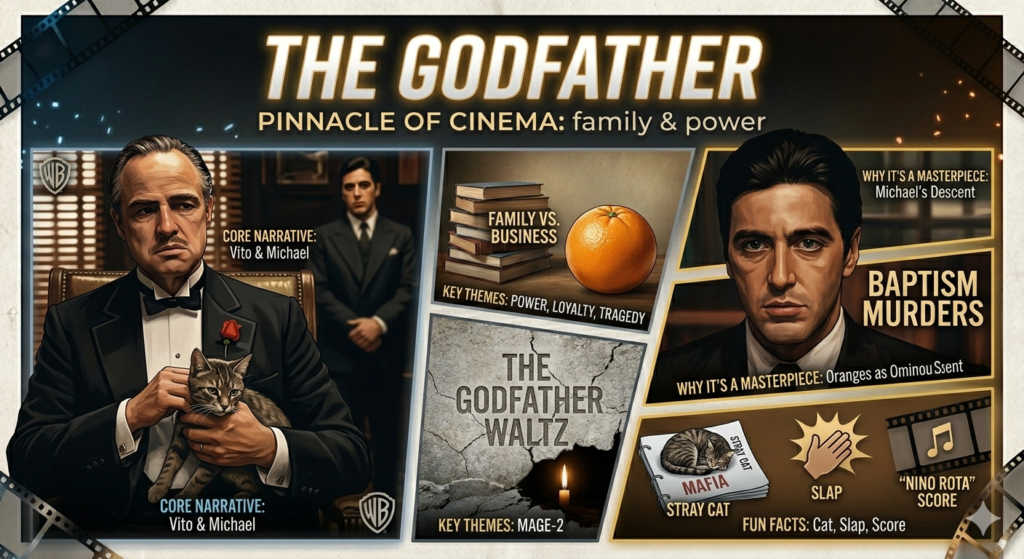
The Godfather (1972). This dynamic collage, designed like a textured film strip and mosaic, visualizes the key sections of your article:
- Row 1 (Core Narrative): A striking contrast between Don Vito Corleone (Marlon Brando), who is balancing brutality with tradition while holding a stray cat, and his youngest son, Michael (Al Pacino), in his dark suit.
- Row 2 (Key Themes): Explores the internal conflict through symbolic imagery: A stack of books titled “FAMILY VS. BUSINESS” next to a single orange—a clear warning of impending death. An abstract graphic representing Nino Rota’s “THE GODFATHER WALTZ” adds a layer of tragic nostalgia, referencing the creative spirit from image_6.png.
- Row 3 (Masterpiece): Dedicated to Michael’s descent into darkness, visualized through the complex visual effects of the “BAPTISM MURDERS” cross-cutting sequence, emphasizing the corruption of innocence.
- Row 4 (Fun Facts): A mosaic of memorable fun facts, including a small “STRAY CAT” curled up on a script where the word “MAFIA” is conspicuously missing, a stylized graphic for the unscripted “SLAP”, and an icon for Nino Rota’s “SCORE”.
The Core Narrative
The story begins in 1945 and follows the Corleone family, one of the “Five Families” of the New York Mafia. At the center is Don Vito Corleone (Marlon Brando), the “Godfather,” a man who balances brutal violence with a strict code of loyalty and honor.
The true emotional arc, however, belongs to his youngest son, Michael Corleone (Al Pacino). A decorated war hero who initially wants nothing to do with the “family business,” Michael is slowly pulled into the world of crime following an assassination attempt on his father. His transformation from an innocent outsider to a cold, calculating Don is one of the most significant character studies in film history.
Key Themes & Symbolism
Coppola used meticulous visual cues to deepen the narrative:
- The Contrast of Light and Dark: Cinematographer Gordon Willis (nicknamed “The Prince of Darkness”) used heavy shadows to represent the moral ambiguity of the characters. The bright, festive wedding at the start contrasts sharply with the dark, secluded office where “business” is conducted.
- Oranges as Ominous Signs: In the world of The Godfather, the presence of oranges almost always foreshadows a death or a tragic event.
- Family vs. Business: The film constantly explores the tension between being a “family man” and a ruthless businessman. The famous line, “It’s not personal, Sonny. It’s strictly business,” encapsulates this cold reality.
Why It Remains a Masterpiece
- The Performances: Marlon Brando’s mumbling, authoritative presence and Al Pacino’s quiet, simmering intensity set new standards for acting.
- The “Baptism Murders” Sequence: This climax is a masterclass in cross-cutting. It intersperses the holy vows of a baptism with the simultaneous, bloody execution of the Corleones’ rivals, perfectly illustrating Michael’s descent into darkness.
- Nino Rota’s Score: The haunting “Love Theme” (The Godfather Waltz) evokes a sense of tragic nostalgia that defines the film’s atmosphere.
Fun Facts You Might Not Know
- The Cat was a Stray: The cat Marlon Brando holds in the opening scene was a stray found on the studio lot. Its purring was so loud it almost muffled Brando’s dialogue in the final edit.
- Real Mob Tension: During production, the real-life Italian-American Civil Rights League (led by mobster Joe Colombo) protested the film. Coppola eventually met with them and agreed to remove the word “Mafia” from the script entirely.
- The Slap was Real: When Vito slaps Johnny Fontane and tells him to “act like a man,” the slap was unscripted. Brando did it to get a genuine reaction out of actor Al Martino.
“I’m gonna make him an offer he can’t refuse.” — Vito Corleone