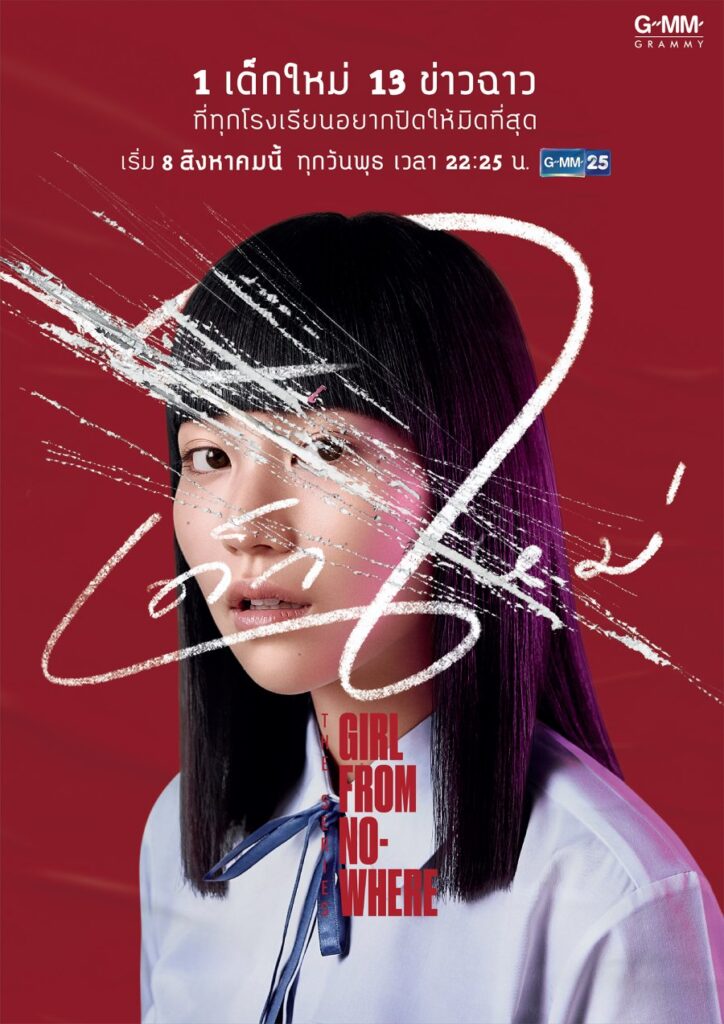
Girl From Nowhere – Full Story & Meaning Explained: Nanno is a mysterious and clever girl who should be avoided when she’s in the area. She transfers to different schools, and when she lands at a new institution, she exposes the lies and misdeeds of the students and faculty at every turn. The girls Nanno encounters often want to try to destroy her, but she always has the upper hand. When a student with a girlfriend gets mistakenly linked to Nanno, he becomes a social media sensation. After the truth about Nanno’s high school life is revealed, she makes sure there are no happy endings.
Introduction: The Girl Who Tests Humanity
Girl From Nowhere (Thai title: เด็กใหม่ – Dek Mai, meaning “The New Kid”) is not merely a thriller—it’s a psychological scalpel dissecting the hypocrisy festering beneath Thailand’s prestigious educational institutions and, by extension, society itself. Since its 2018 Netflix debut, this Thai anthology series has captivated global audiences with its enigmatic protagonist, morally complex narratives, and unflinching social commentary. More than entertainment, Girl From Nowhere functions as a modern morality play where every character faces a simple, terrifying question: What would you do if no one was watching?
Series Overview
| Detail | Information |
|---|---|
| Thai Title | เด็กใหม่ (Dek Mai) |
| International Title | Girl From Nowhere |
| Country | Thailand |
| Genre | Psychological Thriller, Mystery, Supernatural Drama, Anthology |
| Creator/Studio | SOUR Bangkok (GMMTV subsidiary) |
| Lead Actress (Seasons 1–2) | Chicha “Kitty” Amatayakul as Nanno |
| Season 1 | 13 episodes (August–October 2018) |
| Season 2 | 8 episodes (May 2021) |
| Format | Standalone episodes with overarching mythology |
| Rating | TV-MA (mature themes: sexual assault, violence, psychological manipulation) |
The Enigma of Nanno: Who—or What—Is She?
Nanno appears as an ordinary teenage girl with a signature introduction: “My name is Nanno. Nice to meet you.” But she is anything but ordinary. Key traits define her mysterious nature:
- Immortality: Nanno cannot die. She survives drownings, stabbings, and fatal injuries—always reappearing unharmed in a new school [[9]]
- Omniscience: She uncovers secrets others have buried—affairs, crimes, hidden traumas—with uncanny precision
- Temptation: Rather than forcing evil, Nanno creates opportunities for people to reveal their true selves. She offers the knife; they choose to wield it [[35]]
- Ambiguous Morality: She is neither hero nor villain. Nanno exposes corruption but rarely intervenes directly—she sets the stage and lets karma unfold [[57]]
Theories on Nanno’s Identity
The show intentionally leaves Nanno’s origin ambiguous, fueling rich interpretation:
- Karma Personified: Many viewers interpret Nanno as the physical manifestation of karma—the Buddhist law of cause and effect. She doesn’t punish; she creates conditions where people’s actions inevitably return to them [[111]]
- The Tempter (Serpent Archetype): Like the serpent in Eden, Nanno offers forbidden knowledge and opportunities that test human morality. She doesn’t corrupt—she reveals what was already there [[35]]
- “Daughter of Satan” Interpretation: Actress Chicha Amatayakul has referenced this theory in interviews, describing Nanno as Satan’s daughter who tests humanity’s capacity for evil [[52]]. However, creators clarify she is not a judge of justice—she merely exposes truth [[22]]
- Psychological Projection: Some theorists propose Nanno represents the collective guilt and hypocrisy of each school community—a manifestation of their buried sins [[19]]
Crucially: The creators deliberately avoid confirming any single theory. Nanno’s power lies in her ambiguity—she is a mirror reflecting humanity’s capacity for both cruelty and redemption.
Narrative Structure: Anthology of Moral Collapse
Unlike serialized dramas, Girl From Nowhere employs an anthology format. Each episode features:
- A new school setting (elite private institutions across Thailand)
- New characters with hidden sins
- Nanno’s arrival as the catalyst
- A downward spiral triggered by human choices—not Nanno’s direct action
Key Episodes & Themes (Season 1):
| Episode | Title | Core Theme | Real-World Parallel |
|---|---|---|---|
| 1 | “The Ugly Truth” | Appearance vs. substance; beauty obsession | Inspired by Thailand’s fixation on cosmetic surgery |
| 2 | “Apologies” | Empty remorse; performative guilt | Critique of insincere public apologies in Thai culture |
| 3 | “Trophy” | Sexual exploitation by authority figures | Based on real cases of teacher-student abuse in Thai schools [[90]] |
| 4 | “Hi-So” | Classism and wealth worship | Exposes Thailand’s rigid social hierarchy |
| 6–7 | “Wonderwall” (Parts 1–2) | Groupthink and mob mentality | Parallels real-life cyberbullying cases |
| 12–13 | “Trap”/”Thank You Teacher” | Pedophilia and institutional cover-ups | Draws from documented scandals in Thai education |
Each episode functions like a Black Mirror installment—self-contained yet thematically unified by Nanno’s presence [[65]].
Season 2: The Corruption of Power & The Rise of Yuri
Season 2 deepens the mythology by introducing Yuri (Chanya McClory), a bullied student Nanno attempts to help. But Yuri’s arc subverts expectations:
The Yuri Twist
- Initially appearing as a victim needing empowerment, Yuri absorbs Nanno’s influence—and her immortality—after a near-death experience [[34]]
- Unlike Nanno, who reveals truth, Yuri imposes punishment. Where Nanno offers choice, Yuri delivers violent retribution [[74]]
- Yuri represents what happens when Nanno’s power falls into hands driven by personal vengeance rather than cosmic balance
The Finale: “Junko” – When Karma Breaks
The season culminates in a devastating confrontation with Junko (Ploy Sornarin), a wheelchair-bound anatomy prodigy whose mother subjected her to horrific medical abuse:
- Nanno and Yuri clash over methodology: Nanno seeks truth; Yuri demands blood [[73]]
- In the climax, Nanno is stabbed multiple times while protecting others—her most selfless act yet [[73]]
- As Nanno lies bleeding, Yuri transfers Nanno’s blood to Junko, granting her immortality too [[70]]
- The final shot: Junko’s eyes open underwater—suggesting a new, unpredictable force now walks the earth [[69]]
The Meaning: The finale warns that when karma becomes weaponized for personal revenge (Yuri’s approach), it creates an endless cycle of violence. Nanno’s system—flawed but principled—has been fractured.
Deeper Meaning: Beyond Entertainment
1. Critique of Thailand’s Education System
Girl From Nowhere exposes systemic rot beneath Thailand’s revered schools:
- Teachers exploiting students for sex or money
- Administrators covering up crimes to protect institutional reputation
- Students replicating adult corruption through bullying hierarchies [[87]]
The series sparked national conversations about real abuse cases in Thai schools [[90]].
2. Buddhist Philosophy of Karma
Rooted in Thai Buddhist culture, the series explores karma not as divine punishment but as natural consequence:
- Actions plant seeds; circumstances determine when they bear fruit
- Nanno doesn’t create karma—she accelerates its arrival so characters face consequences within their lifetimes [[117]]
- The message: You cannot escape what you’ve done; you can only choose how to face it
3. The Illusion of Choice
A chilling pattern emerges: Nanno rarely forces anyone to act immorally. She simply removes social constraints and watches what emerges. The horror isn’t that people become monsters—it’s that the monster was always there, restrained only by fear of exposure [[57]].
4. Feminist Revenge Narrative
Many episodes center female victims of patriarchal abuse (sexual assault, emotional manipulation) who—through Nanno’s influence—reclaim agency. Yet the series avoids simplistic “girlboss” triumphalism: revenge often corrupts the avenger (Yuri’s arc) or creates new victims [[89]].
Cultural Impact & Legacy
- Global Recognition: Became one of Netflix’s most-watched non-English series in Asia, introducing international audiences to Thai thriller storytelling
- Social Discourse: Sparked Thai media debates about school safety, teacher accountability, and youth mental health
- Fashion Influence: Nanno’s signature school uniform (white blouse, navy skirt, red ribbon) became a cosplay phenomenon
- Critical Acclaim: Praised for avoiding sensationalism—violence and trauma serve thematic purpose rather than shock value
The Future: Girl From Nowhere: The Reset (2026)
In a bold creative decision, creators announced Becky Armstrong (Thai-British actress) will portray a new iteration of Nanno in The Reset, scheduled for March 2026 [[110]]. This reboot acknowledges Nanno as a concept rather than a single person—a force that can inhabit different vessels across time [[107]]. The original Nanno (Kitty Chicha) remains iconic, but the mythology expands beyond one actress.
Note: As of January 2026, no “Season 3” continuing Kitty’s storyline has been officially released. Rumors of 2023/2024 releases were fan speculation or misinformation.
Final Verdict: Why Girl From Nowhere Haunts Us
Girl From Nowhere succeeds because it refuses easy answers. Nanno isn’t an angel punishing sinners or a devil tempting the pure—she is the uncomfortable truth we spend lifetimes avoiding: We are all capable of darkness when the lights go out.
The series’ genius lies in making viewers complicit. We cheer when bullies fall, rapists are exposed, hypocrites unmasked—then pause when Nanno’s methods grow cruel. Are we rooting for justice… or revenge disguised as justice? That discomfort is the point.
In the end, Girl From Nowhere offers no salvation—only revelation. And sometimes, seeing ourselves clearly is the most terrifying punishment of all.
“I’m that girl you never know where I came from… but you’ll remember me when I leave.”
— Nanno’s farewell, echoing long after the screen fades to black