Beam reinforcement calculation is a fundamental aspect of structural engineering that ensures the safety, stability, and durability of concrete beams in construction. Proper reinforcement allows beams to carry loads efficiently by resisting bending moments, shear forces, and deflection. This article provides a step-by-step guide on how to calculate beam reinforcement.
Understanding Beam Reinforcement
Concrete is strong in compression but weak in tension. To overcome this limitation, steel reinforcement bars (rebars) are embedded in the tension zones of concrete beams. The reinforcement must be calculated accurately to resist the applied loads without failure.
Step 1: Gather Design Data
Before starting calculations, collect the following data:
- Beam dimensions: width (b), depth (h), and effective depth (d)
- Material properties: concrete compressive strength (f’c), steel yield strength (fy)
- Load conditions: magnitude and type of loads (dead load, live load, etc.)
- Span length and support conditions
- Design codes: relevant standards such as ACI, Eurocode, or IS codes
Step 2: Calculate Design Loads and Moments
Determine the bending moments acting on the beam using static analysis or provided design loads.
- Calculate factored loads (using load factors from design codes).
- Compute maximum bending moment (Mu) at critical sections, typically mid-span for simply supported beams.
Step 3: Determine Required Steel Area (As)
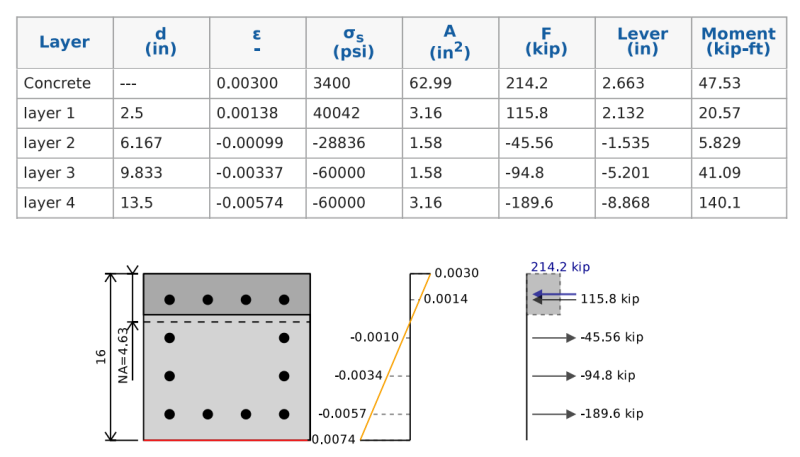
Using the ultimate bending moment (Mu), calculate the required steel reinforcement area.
The fundamental equation for a singly reinforced rectangular beam section is:
Mu = As × fy × (d – a/2)
Where:
- Mu = ultimate moment
- As = area of tensile reinforcement
- fy = yield strength of steel
- d = effective depth
- a = depth of equivalent rectangular stress block
To find ‘a’, use:
a = (As × fy) / (0.85 × f’c × b)
Alternatively, use design charts or iterative methods to solve for As.
Simplified Calculation
For design codes like ACI 318:
- Calculate the nominal moment capacity Mn = Mu / ϕ, where ϕ is the strength reduction factor.
- Use the relation:
Mn = As × fy × (d – a/2)
- Solve for As:
As = Mn / [fy × (d – a/2)]
Since ‘a’ depends on As, iteration or approximation may be needed.
Step 4: Check Minimum and Maximum Reinforcement
Ensure that As complies with code requirements for minimum and maximum reinforcement to avoid brittle failure or excessive cracking.
- Minimum reinforcement prevents sudden failure.
- Maximum reinforcement ensures concrete crushing before steel yielding.
Step 5: Design Shear Reinforcement
Calculate shear forces and provide stirrups or bent-up bars to resist shear. Use design codes to determine required shear reinforcement area.
Step 6: Detail the Reinforcement
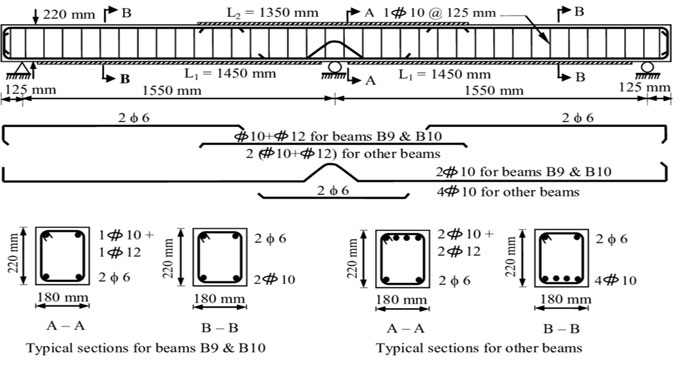
- Choose appropriate bar sizes and spacing.
- Provide adequate anchorage lengths.
- Ensure proper cover for corrosion protection.
Example Calculation
Assume:
- b = 300 mm, h = 500 mm, d = 450 mm
- f’c = 25 MPa, fy = 415 MPa
- Mu = 150 kNm, ϕ = 0.9
Calculate nominal moment:
Mn = Mu / ϕ = 150 / 0.9 = 166.7 kNm = 166,700 Nm
Solve for As:
Assuming ‘a’ small for initial estimate:
As = Mn / (fy × d) = 166,700 / (415 × 450e-3) ≈ 890 mm²
Calculate ‘a’:
a = (As × fy) / (0.85 × f’c × b) = (890 × 415) / (0.85 × 25 × 300) ≈ 57.6 mm
Check if iteration needed; repeat calculation with updated ‘a’ for accuracy.
Conclusion
Beam reinforcement calculation is a critical process involving load analysis, material properties, and design code requirements. Accurate calculations ensure structural safety and longevity. Always refer to the latest design codes and consult a structural engineer when designing reinforced concrete beams.