Discover the cast and plot overview of The Gifted Thai Series, a thrilling drama about gifted students navigating challenges and uncovering mysteries in a prestigious school setting.
Introduction: When Meritocracy Becomes a Weapon
The Gifted (Thai title: นักเรียนพลังกิฟต์ – Nak Rian Plang Gift) is far more than a supernatural teen drama—it’s a razor-sharp critique of Thailand’s rigid educational hierarchy wrapped in sci-fi suspense. Premiering in August 2018 on GMM 25 and LINE TV, this GMMTV production became a cultural lightning rod for its unflinching portrayal of systemic inequality, student exploitation, and the dark side of meritocracy.
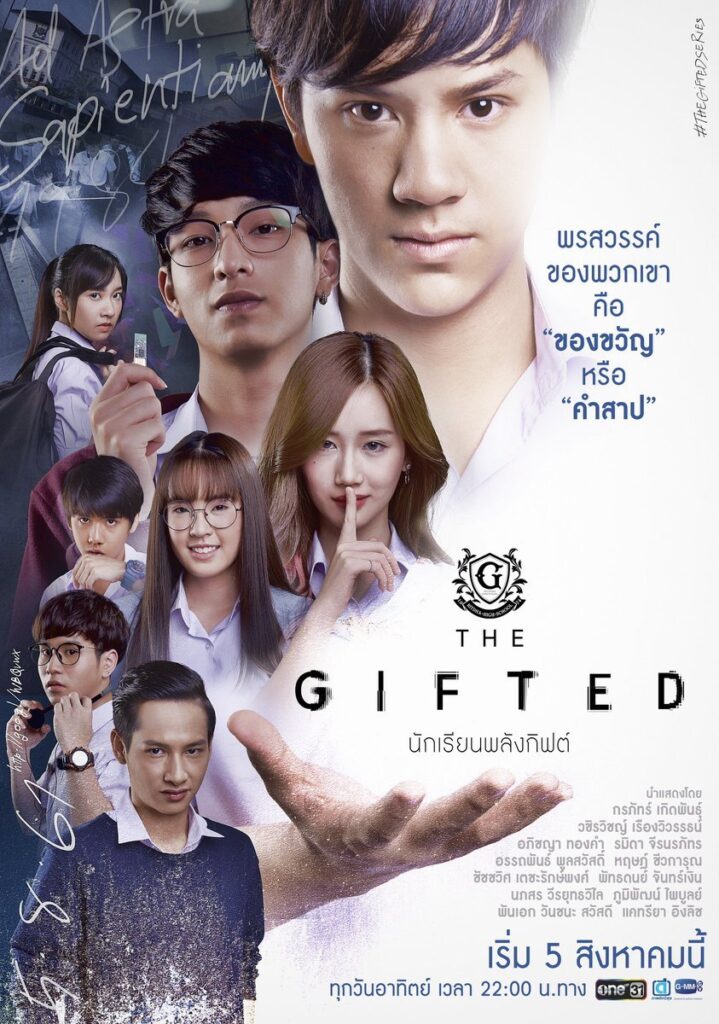
By blending supernatural abilities with real-world social commentary, The Gifted redefined what Thai youth dramas could achieve—proving that genre storytelling could carry profound ethical weight.
Series Overview
| Detail | Information |
|---|---|
| Thai Title | นักเรียนพลังกิฟต์ (Nak Rian Plang Gift) |
| International Title | The Gifted |
| Country | Thailand |
| Genre | Sci-Fi, Psychological Thriller, Social Drama |
| Production | GMMTV × Parbdee Taweesuk |
| Directors | Patha Thongpan, Dhammarong Sermrittirong, Waasuthep Ketpetch, Jarupat Kannula [[107]] |
| Season 1 | 13 episodes (August–October 2018) |
| Sequel | The Gifted: Graduation (8 episodes, September–November 2020) |
| Setting | Fictional Ritdha Wittayakom High School—a microcosm of Thai class stratification |
| Based On | 2015 Thai short film The Gifted |
The Oppressive System: Ritdha High School’s Hierarchy
Before understanding the characters, one must grasp Ritdha High School’s brutal structure:
- Class I (Elite): Top 1% of students—privileged, powerful, groomed for leadership
- Classes II–VII: Middle tiers with diminishing resources and opportunities
- Class VIII (The “Dumping Ground”): Lowest tier where “failures” are discarded with minimal teaching resources [[61]]
Students can only move upward by acing the annual Placement Exam—a near-impossible test designed to maintain the status quo. This system mirrors Thailand’s real educational inequality, where elite schools like Suankularb Wittayalai and Triam Udom Suksa dominate university admissions while rural schools struggle with basic resources.
Main Cast & Their Supernatural Abilities
Season 1 Core Cast
| Actor | Character | Power | Role in Story |
|---|---|---|---|
| Nanon Korapat Kirdpan | Pang (Pawaret Sermrittirong) | Persuasion/Manipulation – Can make anyone obey his commands through physical touch [[83]] | A Class VIII student unexpectedly accelerated to the Gifted Program; uses his power to expose systemic corruption |
| Ohm Pawat Chittsawangdee | Ohm | Pain Absorption/Transfer – Can absorb others’ physical pain and transfer it to himself or redirect it [[79]] | Initially antagonistic toward Pang; evolves into a conflicted ally wrestling with morality |
| Chimon Wachirawit Ruangwiwat | Wave (Wasuthorn Worachotmetee) | Technopathy – Can control and manipulate electronic devices with his mind [[85]] | Tech genius from Class I; joins Pang’s rebellion after witnessing institutional cruelty |
| Lilly Nichapalak Thongkham | Namtaan | Psychometry – Reads emotional imprints and past events by touching objects [[81]] | Empathetic Class I student whose power reveals hidden truths about the school’s dark history |
| Sing Harit Cheewagaroon | Mon | Lie Detection – Instantly knows when someone is lying [[83]] | Loyal friend to Pang; his power becomes crucial in uncovering conspiracies |
| Pattadon Janngeon | Punn (Head Student) | Imitation/Mastery – Perfectly copies any skill or ability after observation [[82]] | Ambitious Class I leader who volunteers for dangerous school competitions; develops dissociative identity disorder from power overuse |
Season 2: The Gifted: Graduation (2020)
Set two years after Season 1, the sequel introduces a new generation of Gifted students while legacy characters return:
| Actor | Character | Power | Arc |
|---|---|---|---|
| Patrick Finkler | Time | Memory Manipulation – Can erase or alter memories [[75]] | Initially seeks to reinstate the banned Gifted Program for personal gain; undergoes moral awakening |
| Phuwin Tangsakyuen | Third | Precognition – Sees fragments of the future [[77]] | New protagonist caught between school administration and student resistance |
| Chanikarn Tangkabodee | Grace | Time Travel – Can physically travel backward in time [[71]] | Initially indifferent rule-bender; power reveals deeper systemic rot |
| Patchata Janngeon | Korn | Telekinesis | Secret leader of the “Anti-Gifted” movement opposing supernatural exploitation [[76]] |
Note: Nanon, Ohm, Chimon, and other Season 1 actors return in supporting/mentor roles as graduating seniors.
Season 1 Plot Summary: The Rebellion Begins
Episode 1–3: The Acceleration
Pang, a struggling Class VIII student, shocks Ritdha by acing the Placement Exam and earning acceleration to Class I. His admission to the secretive Gifted Program—a hidden curriculum for students with supernatural abilities—unlocks his persuasion power. He quickly realizes the program isn’t about nurturing talent but weaponizing students for the school’s benefit [[60]].
Episode 4–8: Uncovering the Conspiracy
Pang allies with Namtaan (whose psychometry reveals a student’s suicide covered up by administration), Wave (who hacks school servers exposing unethical experiments), and Mon (whose lie detection unmasks faculty deception). They discover the Gifted Program forces students to compete in dangerous “Academic Excellence Events” where injuries are common—and deaths are concealed [[61]].
Episode 9–13: The Uprising
The climax centers on Punn, whose power-copying ability fractures his psyche into multiple personalities after absorbing too many skills. When the school administration attempts to lobotomize him to “stabilize” his condition, Pang and allies stage a rebellion. The finale sees students exposing the program’s atrocities publicly—leading to its official cancellation but leaving systemic inequality intact [[63]].
Season 2: The Gifted: Graduation – When Reform Fails
Two years later, Ritdha’s administration—led by the sinister Director Supot—attempts to revive the Gifted Program under a new guise. The sequel explores darker themes:
- The Corruption of Idealism: Time initially believes reinstating the program will “help Gifted students,” ignoring its exploitative history—a critique of well-intentioned reformers who ignore systemic roots [[75]]
- Anti-Gifted Movement: Korn leads students who reject supernatural abilities entirely, arguing powers create dangerous hierarchies within the oppressed [[76]]
- Time Travel’s Ethical Nightmare: Grace’s ability to alter the past raises haunting questions: If you could prevent a tragedy, should you? What unintended consequences follow? [[71]]
- Legacy vs. Revolution: Season 1 graduates (Pang, Wave, etc.) now serve as mentors, wrestling with whether to guide the new generation toward rebellion or compromise [[73]]
The finale delivers a devastating twist: Director Supot isn’t merely corrupt—he’s a former Gifted student whose power (mind-based torture/execution) was weaponized by the Ministry of Education itself [[79]]. The system isn’t broken; it was designed to exploit.
Core Themes & Social Commentary
1. Educational Inequality as Social Control
Ritdha’s class system mirrors Thailand’s real educational apartheid—where students from elite Bangkok schools dominate university admissions while rural students face systemic barriers. The series argues that “meritocracy” often masks inherited privilege.
2. Power Without Ethics = Tyranny
Every Gifted student faces a moral test: Will they use abilities for personal gain, institutional compliance, or collective liberation? Pang’s journey—from self-preservation to sacrificial rebellion—models ethical power use.
3. The Weaponization of Youth
The school’s “Academic Excellence Events” parallel real-world exploitation: Thai students pressured into dangerous competitions (academic Olympiads, military drills) for institutional prestige while their wellbeing is ignored.
4. Trauma & Dissociation
Punn’s fractured psyche serves as metaphor for students broken by impossible expectations—a poignant commentary on Thailand’s youth mental health crisis exacerbated by academic pressure.
Production & Cultural Impact
- Authentic Casting: GMMTV prioritized actors who could portray psychological complexity over typical “pretty boy/girl” tropes—elevating Nanon, Ohm, and Chimon to A-list status [[54]]
- Real-World Dialogue: After airing, Thai educators publicly debated the series’ critique of hierarchical schooling—rare for entertainment to spark policy conversation [[64]]
- International Reach: Became one of Netflix’s most-watched non-English Asian series in 2019–2020, introducing global audiences to Thai sci-fi storytelling
- Legacy: Inspired real Thai students to organize against educational inequality; schools reported increased student activism citing The Gifted as inspiration
Why The Gifted Stands Apart
Unlike typical supernatural dramas where powers exist for spectacle, The Gifted treats abilities as metaphors for privilege:
- Pang’s persuasion = the power of rhetoric/class mobility
- Wave’s technopathy = digital literacy as modern advantage
- Namtaan’s psychometry = emotional intelligence undervalued by systems
The series refuses easy answers. Canceling the Gifted Program doesn’t fix Ritdha’s hierarchy—it merely removes one tool of oppression while the structure remains. This nuanced pessimism—rare in youth dramas—resonates because it mirrors real activism: victories are partial, systems adapt, and the struggle continues.
Final Verdict
The Gifted succeeds because it understands that the most terrifying supernatural force isn’t mind control or time travel—it’s a system that convinces the oppressed to police themselves. By framing this truth through teenagers discovering their power, the series delivers both thrilling entertainment and urgent social critique.
For viewers seeking more than romance-of-the-week Thai dramas, The Gifted offers intellectually rigorous storytelling where every superpower carries ethical weight—and every victory comes with moral cost. It remains essential viewing for understanding modern Thai youth culture and the global fight against educational injustice.
“They don’t want us to be gifted. They want us to be weapons.”
— Pang’s realization that defines the series’ haunting core truth