Columns are essential structural elements in buildings and other constructions, responsible for transferring loads from the structure above to the foundation below. Understanding how to calculate the load bearing capacity of columns is crucial for ensuring safety, stability, and durability of any structure. This blog post will guide you through the fundamental concepts and step-by-step procedures to calculate the load bearing capacity of columns.
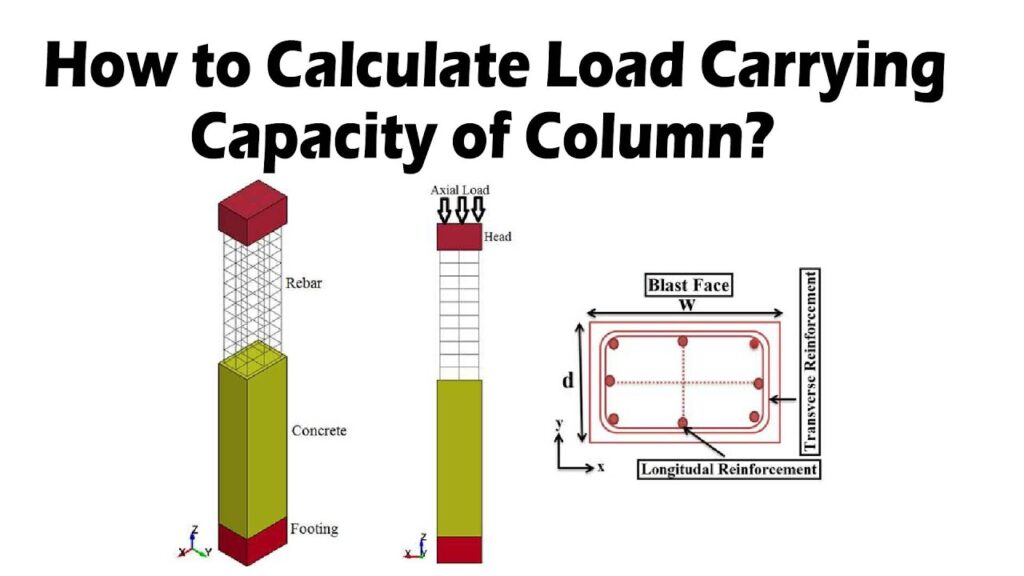
What is Load Bearing Capacity?
Load bearing capacity refers to the maximum load a column can safely carry without failure. It includes the weight of the structure itself (dead load), any live loads (people, furniture, equipment), and environmental loads (wind, seismic).
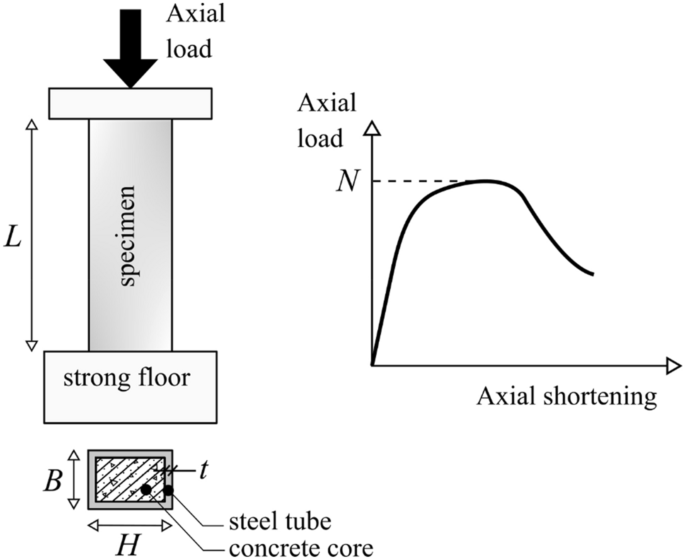
Types of Loads on Columns
- Axial Loads: Loads applied along the longitudinal axis of the column.
- Eccentric Loads: Loads applied with an offset from the column’s center axis, causing bending.
- Combined Loads: A combination of axial and bending loads.
Factors Affecting Load Bearing Capacity
- Material Strength: Different materials (concrete, steel, timber) have different strengths.
- Column Size and Shape: Cross-sectional area and shape influence capacity.
- Slenderness Ratio: Ratio of effective length to radius of gyration affects buckling behavior.
- End Conditions: Whether the column ends are fixed, pinned, or free changes the effective length.
- Load Type: Axial or eccentric loads impact the failure mode.
Step-by-Step Guide to Calculate Load Bearing Capacity
Step 1: Determine Column Dimensions and Material Properties
- Identify the cross-sectional dimensions (width, depth, diameter).
- Obtain material properties such as compressive strength (f’c for concrete) or yield strength (fy for steel).
Step 2: Calculate Cross-Sectional Area (A)
For example, for a rectangular column:
[ A = width \times depth ]
For a circular column:
[ A = \pi \times (diameter/2)^2 ]
Step 3: Calculate the Axial Load Capacity (P)
For concrete columns without reinforcement, the axial load capacity is approximately:
[ P = 0.85 \times f’_c \times A ]
For reinforced concrete columns:
[ P = 0.85 \times f’_c \times (A_g – A_s) + f_y \times A_s ]
Where:
- ( A_g ) = gross area of the column
- ( A_s ) = area of steel reinforcement
- ( f_y ) = yield strength of steel
For steel columns:
[ P = A \times f_y ]
Step 4: Calculate Slenderness Ratio (λ)
[ \lambda = \frac{L_{eff}}{r} ]
Where:
- ( L_{eff} ) = effective length of the column (depends on end conditions)
- ( r = \sqrt{\frac{I}{A}} ) (radius of gyration)
- ( I ) = moment of inertia of the cross-section
Step 5: Check for Buckling
For slender columns, buckling reduces load capacity. Use Euler’s critical load formula for buckling:
[ P_{cr} = \frac{\pi^2 \times E \times I}{(L_{eff})^2} ]
Where:
- ( E ) = modulus of elasticity of the material
Compare ( P_{cr} ) with axial load capacity; the lesser value governs design.
Step 6: Consider Eccentric Load Effects (if any)
If the load is eccentric, calculate bending moment:
[ M = P \times e ]
Where ( e ) is the eccentricity.
Then use interaction formulas (from design codes) to ensure combined axial and bending stresses do not exceed allowable limits.
Safety Factors and Design Codes
Always apply safety factors as per local building codes (e.g., ACI, Eurocode, IS codes). These factors account for uncertainties in material properties, load estimations, and workmanship.
Example Calculation
Consider a reinforced concrete rectangular column:
- Width = 300 mm
- Depth = 500 mm
- Concrete strength ( f’_c = 25 \, MPa )
- Steel reinforcement area ( A_s = 4000 \, mm^2 )
- Steel yield strength ( f_y = 415 \, MPa )
- Effective length ( L_{eff} = 3 m )
Calculate:
- Cross-sectional area ( A_g = 300 \times 500 = 150,000 \, mm^2 )
- Concrete effective area ( A_c = A_g – A_s = 150,000 – 4,000 = 146,000 \, mm^2 )
- Concrete load capacity = ( 0.85 \times 25 \times 146,000 = 3,102,500 \, N )
- Steel load capacity = ( 415 \times 4,000 = 1,660,000 \, N )
- Total load capacity ( P = 3,102,500 + 1,660,000 = 4,762,500 \, N ) or approximately 4.76 MN
Conclusion
Calculating the load bearing capacity of columns is a vital part of structural design, ensuring safety and functionality. By understanding the material properties, dimensions, load types, and applying relevant formulas and safety factors, engineers can design robust columns capable of supporting intended loads. Always refer to local codes and standards for detailed design requirements.
Feel free to ask questions or share your experiences related to column design and load calculations in the comments below!