Accurate material estimation is the cornerstone of any successful construction project, big or small. Whether you’re a professional contractor pricing a job, a DIY enthusiast tackling a garden wall, or a developer planning a large-scale build, knowing exactly how many bricks, bags of cement, and cubic meters of sand you need is critical. Underestimate, and you face costly delays and rushed orders. Overestimate, and you tie up capital in unused materials that clutter the site and may spoil.
This guide will provide a step-by-step framework for calculating the quantities required for brick masonry. We will start with the fundamental concepts, walk through detailed calculations, and conclude with essential pro tips to ensure your estimates are both accurate and practical.
Chapter 1: The Foundation: Understanding Key Variables
Before you can calculate anything, you need to understand and gather a few pieces of essential information. The entire estimation process hinges on these variables.
- Wall Type and Thickness:
- Single-Brick Wall (½-Brick Wall): A wall with a thickness equal to the width of one brick. Often used for non-load-bearing partitions. (e.g., 102.5mm thick for a standard brick).
- Double-Brick Wall (1-Brick Wall): A wall with a thickness equal to the length of one brick. This is a standard load-bearing wall. (e.g., 215mm thick for a standard brick).
- Cavity Wall: Two single-brick walls with a gap (cavity) between them. Each leaf (skin) of the wall must be calculated separately.
- Brick Size: This is the most critical dimension. Brick sizes vary by country and manufacturer. It is imperative to confirm the actual size of the bricks you will be using. Some common standard sizes include:
- Modular (US): 7 ⁵⁄₈” x 3 ⁵⁄₈” x 2 ¹⁄₄” (194mm x 92mm x 57mm)
- Standard (UK): 215mm x 102.5mm x 65mm
- Metric: 290mm x 90mm x 90mm
- For this guide, we will use the UK Standard brick: 215mm x 102.5mm x 65mm.
- Mortar Joint Thickness: The thickness of the mortar between bricks. A standard thickness is 10mm (0.4 inches). This small dimension has a significant cumulative effect on the number of bricks required.
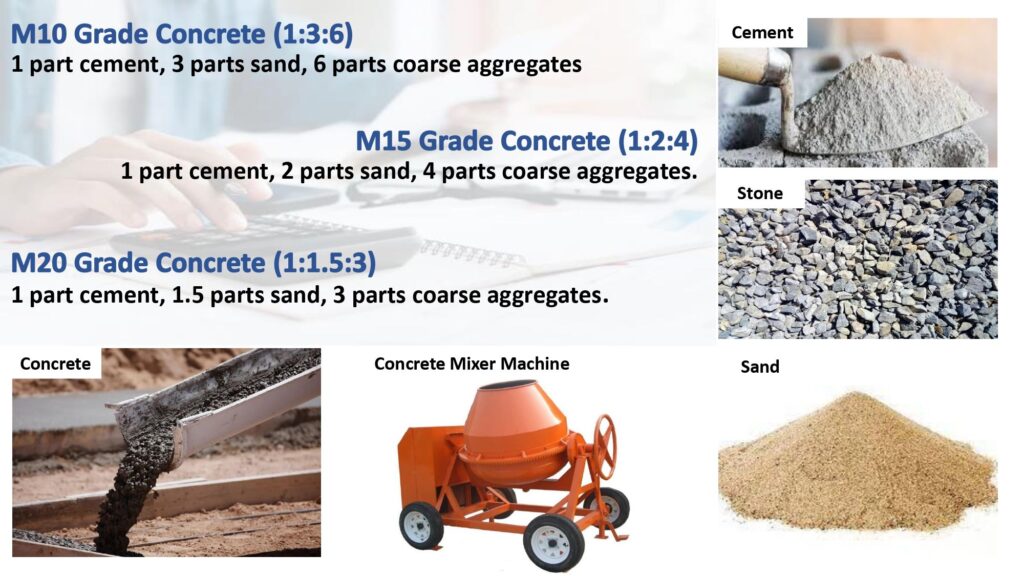
- Mortar Mix Ratio: The proportion of cement to sand in the mortar. Common ratios for bricklaying are:
- 1:3 (Very strong, for structural work)
- 1:4 (Good for general above-grade work)
- 1:5 (For non-load-bearing walls)
- We will use a standard 1:4 ratio for our calculations.
- Wall Volume: The total volume of the masonry structure you are building, calculated as:
Volume of Wall = Length × Height × Thickness
Chapter 2: The Step-by-Step Calculation Process
Let’s work through a real-world example.
Project: Build a garden wall that is 10 meters long, 1.5 meters high, and of single-brick thickness.
Given:
- Brick Size: 215mm x 102.5mm x 65mm
- Mortar Joint Thickness: 10mm
- Mortar Mix Ratio: 1:4 (Cement : Sand)
- Wall Dimensions: L=10m, H=1.5m, T=102.5mm (0.1025m)
Step 1: Calculate the Number of Bricks
The most accurate method is to calculate the number of bricks per square meter (or per square foot) and then multiply by the total wall area.
A) Calculate the Area of a Single Brick including Mortar Joints:
When a brick is laid, it is surrounded by mortar. Therefore, the space each brick occupies is its own dimensions plus the mortar joint on each side.
- Brick Length (with mortar) = 215mm + 10mm = 225mm = 0.225m
- Brick Height (with mortar) = 65mm + 10mm = 75mm = 0.075m
- Area per Brick = Length (with mortar) × Height (with mortar)
- Area per Brick = 0.225m × 0.075m = 0.016875 m²
B) Calculate the Total Wall Area:
- Wall Area = Length × Height = 10m × 1.5m = 15 m²
C) Calculate the Number of Bricks:
- Number of Bricks = Total Wall Area / Area per Brick
- Number of Bricks = 15 m² / 0.016875 m² ≈ 889 Bricks
Always add a waste factor! Bricks break, get cut, and mistakes happen. A standard waste factor is 5% to 10%.
- Waste = 889 × 0.05 ≈ 44 bricks
- Total Bricks Required = 889 + 44 = 933 Bricks
Pro Tip: You will often see a standard figure of 60 bricks per square meter for a single-brick wall. This is a useful rule of thumb to quickly check your math. Our detailed calculation yielded 889 bricks / 15 m² = 59.3 bricks/m², confirming this rule.
Step 2: Calculate the Volume of Mortar Required
The mortar fills the joints between the bricks. The total volume of mortar can be estimated as a percentage of the total wall volume or calculated directly. The percentage method is more common for estimates.
A) Calculate the Volume of the Wall:
- Wall Volume = Length × Height × Thickness
- Wall Volume = 10m × 1.5m × 0.1025m = 1.5375 m³
B) Calculate the Volume of Mortar:
A well-established rule is that mortar accounts for approximately 15% to 25% of the total wall volume. For our standard brick with 10mm joints, we’ll use 20%.
- Wet Mortar Volume = 20% of Wall Volume
- Wet Mortar Volume = 0.20 × 1.5375 m³ = 0.3075 m³
C) Account for Dry Volume of Mortar:
When mixed with water, the volume of mortar reduces. This is known as “shrinkage.” To get the volume of dry ingredients (cement and sand), we must increase the wet volume by 25% to 33%. We’ll use 33%.
- Dry Mortar Volume = Wet Mortar Volume × 1.33
- Dry Mortar Volume = 0.3075 m³ × 1.33 ≈ 0.409 m³
Step 3: Calculate the Quantities of Cement and Sand
Now we use the dry mortar volume and our 1:4 mix ratio to find the individual quantities.
The mix ratio 1:4 has a total of 1 + 4 = 5 parts.
A) Calculate the Volume of One Part:
- Volume of One Part = Total Dry Mortar Volume / Total Number of Parts
- Volume of One Part = 0.409 m³ / 5 ≈ 0.0818 m³
B) Calculate the Volume of Cement:
- Cement Volume = Volume of One Part × Number of Cement Parts
- Cement Volume = 0.0818 m³ × 1 = 0.0818 m³
C) Convert Cement Volume to Bags:
Cement is sold in 50kg bags. The density of cement is approximately 1440 kg/m³.
- Cement Weight = Cement Volume × Density
- Cement Weight = 0.0818 m³ × 1440 kg/m³ ≈ 117.8 kg
- Number of Bags = Total Cement Weight / 50 kg per bag
- Number of Bags = 117.8 kg / 50 kg/bag ≈ 2.36 bags
Always round up for materials you can’t buy in fractions.
- Total Bags of Cement Required = 3 Bags
D) Calculate the Volume of Sand:
- Sand Volume = Volume of One Part × Number of Sand Parts
- Sand Volume = 0.0818 m³ × 4 = 0.3272 m³
Sand is usually ordered by the cubic meter, tonne, or truckload. The density of dry sand is about 1600 kg/m³.
- Sand Weight = 0.3272 m³ × 1600 kg/m³ ≈ 524 kg (or 0.524 tonnes)
Final Material List for the Project:
- Bricks: 933
- Cement (50kg bags): 3
- Sand: 0.33 m³ (or approximately 525 kg)
Chapter 3: Pro Tips and Practical Considerations
- The “Tally” Method for Bricks: For quick estimates, use standard tallies. For a single-brick wall: 60 bricks/m². For a double-brick wall: 120 bricks/m². Adjust for your specific brick size.
- Waste Factors are Not Optional:
- Bricks: 5-10% for standard shapes, up to 15-20% for complex patterns or large projects with many cuts.
- Mortar: 10-15% for spillage, cleaning tools, and uneven mixing.
- Bulk Materials are Cheaper: While buying 3 bags of cement is correct for our small wall, for larger projects, ordering bulk cement and sand by the cubic meter is far more cost-effective.
- Don’t Forget Water: You’ll need a clean, accessible water source on site. The amount of water is roughly half the volume of cement, but this is highly variable based on the sand’s moisture content.
- Other Materials:
- Wall Tie: For cavity walls, remember to estimate the number of wall ties (typically every 450-900mm horizontally and every 450mm vertically).
- Damp Proof Course (DPC): Calculate the linear meters of DPC required (same as the wall length).
- Software is Your Friend: For complex projects with openings (doors, windows), use construction estimating software or CAD tools. They can automatically subtract openings and generate precise material take-offs.
Summary and Quick Reference Formula
To recap the core process for any project:
- Bricks:
- Area per Brick (with mortar) = (Brick L + Joint) × (Brick H + Joint)
- Number of Bricks = (Wall Area / Area per Brick) + Waste%
- Mortar:
- Wet Mortar Volume = Wall Volume × 20% (0.2)
- Dry Mortar Volume = Wet Mortar Volume × 1.33
- Cement & Sand (for 1:4 mix):
- Cement Volume = Dry Mortar Volume × (1/5)
- Cement Bags = (Cement Volume × 1440) / 50
- Sand Volume = Dry Mortar Volume × (4/5)
By following this structured approach, you can move from a simple sketch to a confident, accurate material order, ensuring your masonry project is built on a foundation of precise planning and financial control.