Learn how to calculate staircase dimensions like a pro. Our step-by-step guide covers rise & run, headroom, and key building codes for a safe, beautiful, and functional staircase in your home.
How to Calculate Staircase Dimensions Properly: A Guide to Safety, Comfort, and Style
There’s a certain magic to a staircase. It’s more than just a functional element connecting two floors; it’s a sculptural centerpiece, a pathway to private sanctuaries, and a powerful design statement. But behind every graceful, sweeping staircase or every sleek, modern flight is a foundation of precise mathematics and building science.
Getting the dimensions wrong can lead to a staircase that feels awkward, is unsafe to use, and fails to meet building codes. But get it right, and you create a seamless flow in your home that is both beautiful and ergonomic.
In this guide, we’ll demystify the process and give you the confidence to understand, plan, and calculate your staircase dimensions properly.
The Anatomy of a Staircase: Key Terms to Know
Before we crunch the numbers, let’s get familiar with the language of staircases:
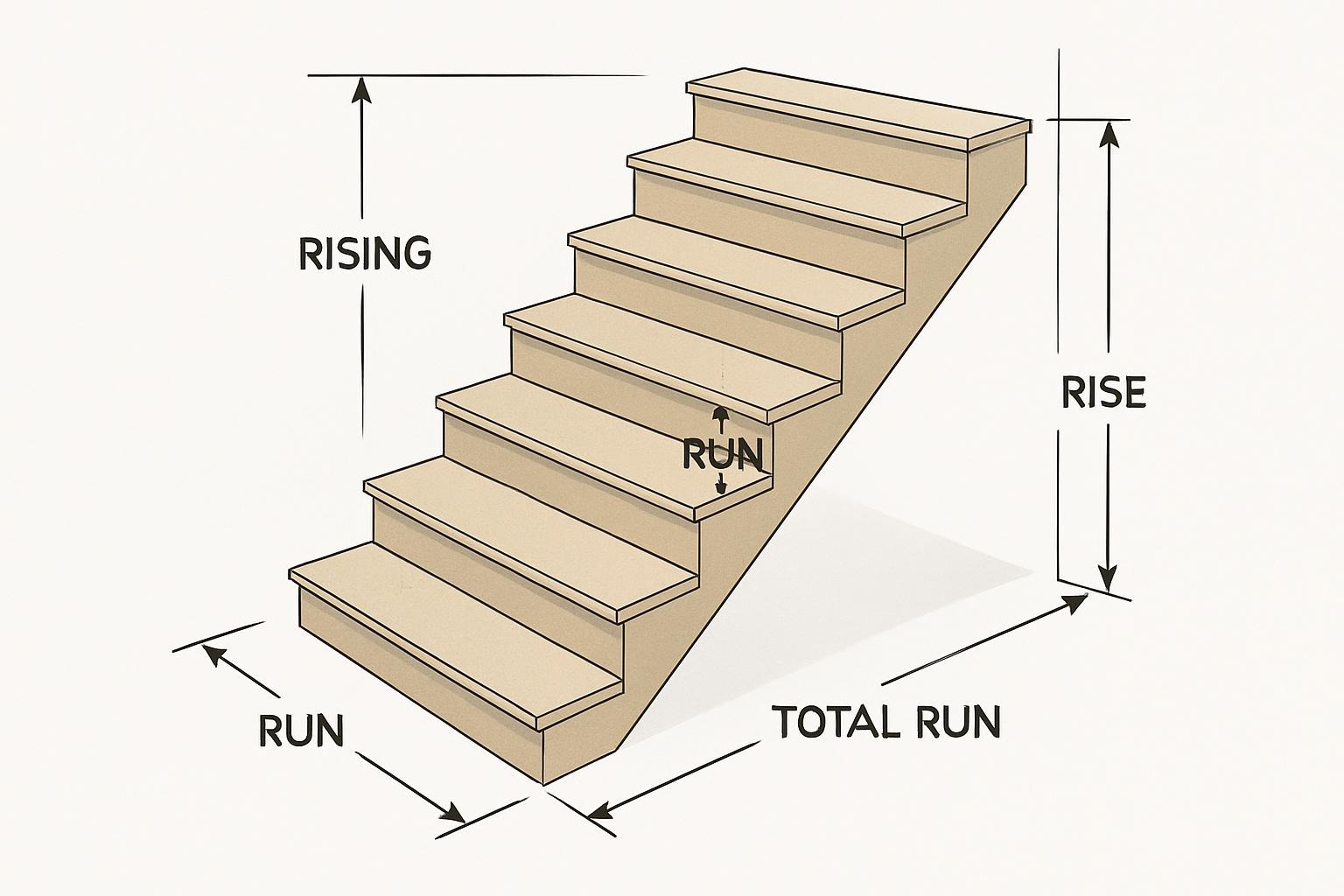
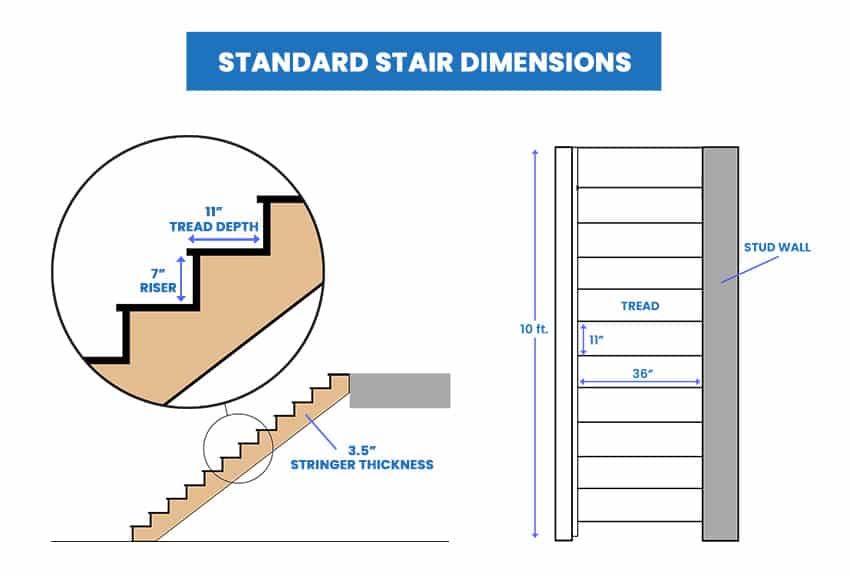
- Tread: The horizontal part you step on.
- Riser: The vertical part between each tread.
- Rise: The total vertical height from one floor to the next.
- Run: The total horizontal length of the staircase.
- Nosing: The edge of the tread that overhangs the riser below.
- Stringer: The structural side support that holds the treads and risers (can be open or closed).
- Headroom: The clear vertical height from the nosing of any tread to the ceiling above.
The Golden Rule: The Rise-Run Formula
At the heart of staircase design is a simple, time-tested formula that ensures comfort and safety. It’s often called the “Goldilocks Zone” for stairs—not too steep, not too shallow, but just right.
The most common rule of thumb is:
2R + T = 25 inches
(where R is the Riser height and T is the Tread depth)
For example:
- A 7-inch riser and a 10-inch tread fit perfectly: (2 × 7) + 10 = 24 inches.
- A 7.5-inch riser and an 11-inch tread also work: (2 × 7.5) + 11 = 26 inches.
This formula creates a natural, comfortable stride for most people.
Step-by-Step Calculation Guide
Follow these steps to calculate the dimensions for a standard straight-run staircase.
Step 1: Measure the Total Rise
This is the most critical starting point. You need the exact vertical distance from the finished floor of the lower level to the finished floor of the upper level.
- How to do it: Use a long level and a tape measure, or a laser measure for accuracy. Let’s assume our Total Rise is 105 inches.
Step 2: Determine the Number of Risers
You can’t have a fraction of a step, so we need a whole number. Building codes typically mandate a maximum riser height of 7.75 inches.
- Calculation: Total Rise ÷ Desired Riser Height
- 105 inches ÷ 7 inches (a comfortable target) = 15 risers.
Since you always have one more riser than treads (the top floor acts as the final “step”), this means we will have 15 risers.
Step 3: Calculate the Exact Individual Riser Height
Now, we refine our calculation to get a perfectly even height for every step.
- Calculation: Total Rise ÷ Number of Risers
- 105 inches ÷ 15 = 7 inches exactly.
This is an ideal result—a 7-inch riser is very comfortable and well within code.
Step 4: Determine the Number of Treads
As mentioned, the number of treads is one less than the number of risers.
- Calculation: Number of Risers – 1
- 15 risers – 1 = 14 treads.
Step 5: Calculate the Individual Tread Depth (Run)
Now, let’s apply our golden rule. Using the formula 2R + T = 25, we can solve for T (Tread).
- Calculation: 25 – (2 × R) = T
- 25 – (2 × 7) = 25 – 14 = 11 inches.
An 11-inch tread depth is excellent and provides plenty of room for a secure footing.
Step 6: Calculate the Total Run
This tells you how much horizontal space the staircase will occupy.
- Calculation: Number of Treads × Tread Depth
- 14 treads × 11 inches = 154 inches (or 12 feet, 10 inches).
This is a crucial measurement for planning your space!
Don’t Forget These Critical Code & Comfort Factors
While the rise and run are the stars of the show, these supporting actors are just as important:
- Headroom: Most building codes require a minimum of 80 inches of clear headroom at all points. When walking up the stairs, you should never have to duck. Always check the clearance above the staircase.
- Stair Width: For main staircases in a home, a minimum width of 36 inches is standard. Wider is always better for comfort and moving furniture.
- Handrails: Required for stairs with more than three risers. They should be between 34 and 38 inches high measured from the nosing of the treads.
- Consistency: Perhaps the most critical safety rule: all risers and all treads must be identical. Even a small variation can cause trips and falls, as people subconsciously expect a consistent rhythm.
A Note on Style: How Dimensions Influence Design
The dimensions you choose can subtly influence the style of your staircase:
- Low Rise & Deep Run (e.g., 6″ rise, 12″ run): Creates a grand, luxurious, and leisurely feel. Common in classic and traditional homes.
- Steeper Stairs (e.g., 7.75″ rise, 9″ run): Often found in space-saving situations like lofts or cottage-style homes. They feel more utilitarian and compact.
- Open Riser Stairs: Where risers are omitted for a modern, airy look. Building codes are strict here, typically requiring that a 4-inch sphere cannot pass through the opening to prevent small children from falling.
When to Call a Professional
While calculating basic dimensions is a fantastic DIY exercise, the construction of a staircase is complex.
You should absolutely consult a structural engineer, architect, or experienced carpenter if:
- Your design is not a simple straight run (e.g., L-shaped, U-shaped, spiral, or curved).
- You are modifying an existing structure.
- You have any doubts about meeting local building codes, which can vary and may be more stringent than general guidelines.
Referrals for Further Reading
To deepen your knowledge, here are some excellent resources:
- The International Residential Code (IRC) – Chapter 3: Building Planning
- What it is: The definitive source for building code requirements in most of the United States. It’s technical but authoritative.
- Best for: Understanding the legal minimums and maximums for safety.
- “Graphic Guide to Frame Construction” by Rob Thallon
- What it is: A classic visual guide for builders and serious DIYers. It has incredibly clear, detailed illustrations of stair framing and construction.
- Best for: Visual learners who want to understand the structural “how-to.”
- The Spruce: “Stair Calculator”
- What it is: An online tool that does the math for you. Input your total rise, and it will calculate the number of steps, rise, and run.
- Best for: Quickly double-checking your manual calculations.
- Fine Homebuilding Magazine (Website and Podcast)
- What it is: A treasure trove of expert advice from master builders. Search their archives for articles on advanced stair-building techniques and design insights.
- Best for: Learning professional tips and tricks for a high-quality finish.
Conclusion: Build Your Foundation in Good Design
Calculating your staircase dimensions is the first and most crucial step in a successful project. By respecting the timeless relationship between rise and run, adhering to building codes for safety, and considering the aesthetic impact of your choices, you can ensure your new staircase will be a functional piece of engineering and a beautiful work of art that you’ll enjoy for years to come.
Happy building