In the realm of civil engineering and structural design, understanding the types of loads that act on a structure is crucial for ensuring safety, stability, and longevity. Two fundamental types of loads that every engineer must consider are dead loads and live loads. These loads significantly influence the design and analysis of buildings, bridges, and other structures. This comprehensive blog post explores the concepts of dead load and live load, their differences, implications in structural design, and practical examples, supplemented with references from authoritative books in the field.
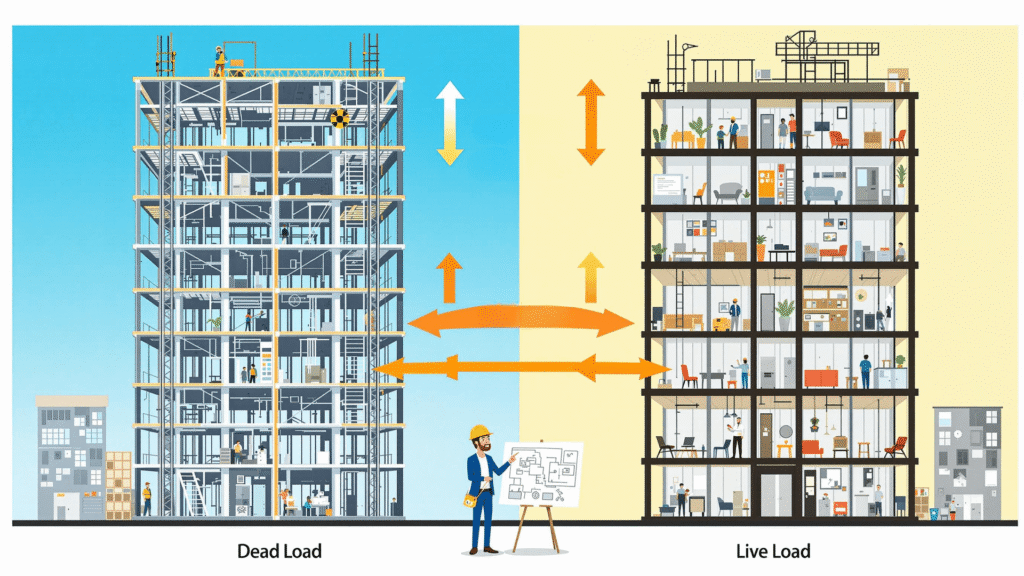
Table of Contents
- Introduction to Structural Loads
- What is Dead Load?
- What is Live Load?
- Key Differences Between Dead Load and Live Load
- Importance of Understanding Dead and Live Loads in Structural Design
- Methods of Calculating Dead Load and Live Load
- Impact of Dead and Live Loads on Structural Elements
- Case Studies and Real-Life Applications
- Building Codes and Standards Regarding Loads
- Challenges and Considerations in Load Management
- Summary
- Recommended Books and References
1. Introduction to Structural Loads
Every structure, whether a house, commercial building, bridge, or tower, must be designed to withstand different types of forces or loads. These loads can be static or dynamic, predictable or variable, and each has unique characteristics that affect the structure’s behavior.
Loads in structural engineering generally refer to the forces or other actions that cause stresses, deformations, or displacements in a structure. Properly identifying and analyzing these loads is essential to prevent structural failure, ensure safety, and optimize material usage.
Among the various loads, dead load and live load are two primary categories forming the basis of load classification in structural engineering.

2. What is Dead Load?
Dead load refers to the permanent, static weight of the structure and any other fixed components attached to it. This includes the weight of structural elements such as beams, columns, floors, walls, roofs, and any fixed installations like built-in cabinets and plumbing systems.

Characteristics of Dead Load:
- Permanent: Dead loads remain constant throughout the structure’s lifetime unless modifications are made.
- Known and Predictable: Since dead loads involve the weight of materials used, they can be calculated with reasonable accuracy.
- Static Load: Dead loads do not change over time or due to occupancy and environmental conditions.
Examples of Dead Loads:
- Weight of structural members: steel beams, concrete slabs, masonry walls.
- Fixed equipment and machinery.
- Flooring materials, ceiling panels.
- Roofing materials.
Calculation of Dead Load:
Calculating dead load involves determining the volume and density of materials used. For example, the dead load of a concrete slab can be calculated by:
[ \text{Dead Load} = \text{Volume} \times \text{Density of concrete} ]
Where density of concrete typically is around 24 kN/m³ (kilonewtons per cubic meter).
3. What is Live Load?
Live load refers to the transient, variable loads that the structure experiences during its usage. These are loads imposed on a building by occupants, furniture, movable equipment, vehicles, and environmental factors such as snow or wind.
Characteristics of Live Load:
- Variable and Dynamic: Live loads can change in magnitude and location over time.
- Unpredictable: Unlike dead loads, live loads depend on human activity and environmental conditions, making them less predictable.
- Temporary: Live loads may act intermittently or for short durations.
Examples of Live Loads:
- People walking, sitting, or working inside a building.
- Office furniture, movable partitions, appliances.
- Vehicles on a bridge or parking structure.
- Snow accumulation on roofs.
Calculation of Live Load:
Live loads are generally specified by building codes and standards based on the building’s usage type. For instance:
- Residential buildings might have a live load requirement of 1.5 to 2.0 kN/m².
- Office buildings might require 2.5 to 3.0 kN/m².
- Storage facilities have higher live load requirements.
4. Key Differences Between Dead Load and Live Load
| Aspect | Dead Load | Live Load |
|---|---|---|
| Nature | Permanent and static | Temporary and dynamic |
| Origin | Weight of structural components | Occupants, furniture, vehicles |
| Variability | Constant | Variable and unpredictable |
| Calculation Basis | Material density and volume | Building codes and occupancy type |
| Influence on Design | Foundation and structural size | Safety factors and load combinations |
| Effect on Structure | Causes constant stresses | Causes variable stresses |
| Examples | Concrete slab, walls, beams | People, furniture, snow |
5. Importance of Understanding Dead and Live Loads in Structural Design
Accurate assessment of both dead and live loads is fundamental to:
- Structural Safety: Ensuring that the structure can safely carry all anticipated loads without failure.
- Serviceability: Minimizing excessive deflections, vibrations, or damage over time.
- Economic Efficiency: Avoiding overdesign which can lead to increased costs.
- Compliance: Meeting building codes and standards.
Ignoring or underestimating live loads can lead to catastrophic failure during occupancy, while neglecting dead loads can cause foundational issues and structural collapse.
6. Methods of Calculating Dead Load and Live Load
Dead Load Calculation:
- Identify all structural elements: slabs, beams, columns, walls, roofing.
- Determine material densities: concrete (24 kN/m³), steel (78.5 kN/m³), masonry (18-22 kN/m³).
- Calculate volume: length × width × thickness.
- Multiply volume by density: to obtain weight.
- Sum all components: to determine total dead load.
Live Load Calculation:
- Refer to applicable codes: such as the American Society of Civil Engineers (ASCE 7), Eurocode, or local standards.
- Determine occupancy type: residential, commercial, industrial.
- Use prescribed live load values: from tables based on usage.
- Adjust for factors: such as load combinations, reduction factors, and impact factors.
7. Impact of Dead and Live Loads on Structural Elements
- Beams and Slabs: Must be designed to carry both dead and live loads without excessive deflection.
- Columns: Carry axial loads from dead and live loads.
- Foundations: Must support the total load (dead + live) transmitted from the structure.
- Connections: Designed to transfer combined loads safely.
8. Case Studies and Real-Life Applications
Case Study 1: Residential Building
- Dead loads calculated based on concrete slabs, brick walls, and finishes.
- Live loads considered as per occupancy (e.g., 2 kN/m²).
- Structural design optimized to balance safety and cost.
Case Study 2: Bridge Design
- Dead load includes the weight of the bridge deck, girders, and cables.
- Live load includes vehicles, pedestrian traffic, and environmental loads.
- Load combinations ensure safety under maximum load scenarios.
9. Building Codes and Standards Regarding Loads
- ASCE 7 – Minimum Design Loads for Buildings and Other Structures: Provides detailed requirements for dead and live loads.
- Eurocode EN 1991: Covers actions on structures including dead and live loads.
- IBC (International Building Code): Specifies live loads based on occupancy.
- IS 875 (Indian Standard): Part 1 for dead loads, Part 2 for live loads.
These codes provide guidelines on load values, load combinations, safety factors, and design procedures.
10. Challenges and Considerations in Load Management
- Variable Live Loads: Difficult to predict exact magnitudes and locations.
- Load Combinations: Structures must be designed to withstand various possible combinations of dead and live loads.
- Environmental Loads: Snow, wind, and seismic forces can act as live or special loads.
- Future Modifications: Changes in occupancy or usage may increase live loads.
- Load Reduction Factors: Applied to adjust live loads based on probability and risk.
11. Summary
Understanding the difference between dead load and live load is fundamental in structural engineering. Dead loads are permanent, predictable weights of structural components, while live loads are variable, transient forces due to occupancy and use. Both loads must be carefully calculated and combined to ensure safe, functional, and economical structures. Adhering to relevant codes and employing sound engineering judgment are essential for effective load management.
12. Recommended Books and References
- “Structural Analysis” by R.C. Hibbeler
- A comprehensive textbook covering basics of loads, structural analysis, and design principles.
- “Design of Reinforced Concrete” by S. Unnikrishna Pillai and Devdas Menon
- Offers detailed insights into load considerations in concrete design.
- “Principles of Structural Design: Wood, Steel, and Concrete” by Ram S. Gupta
- Discusses various load types and their influence on multiple materials.
- “Structural Load Determination” by Richard O. Claus and John M. Niedzwecki
- Focuses specifically on load calculations and load management.
- “Building Structures” by James Ambrose and Patrick Tripeny
- Provides practical design examples including load