Concrete is one of the most widely used construction materials in the world, owing to its strength, durability, and versatility. A key to achieving high-quality concrete is mixing the right proportions of cement, sand, and aggregate. Whether you are a DIY enthusiast, a civil engineering student, or a professional builder, understanding how to calculate the quantities of these materials is essential to ensure the strength and durability of your concrete structure.

In this blog post, we will walk you through the step-by-step process of calculating the amount of cement, sand, and aggregate needed for your concrete mix.
Understanding the Components of Concrete
Before we dive into the calculations, let’s understand the roles of each component in concrete:
- Cement: Acts as a binder that holds all the materials together.
- Sand (Fine Aggregate): Fills the gaps between the coarse aggregates.
- Aggregate (Coarse Aggregate): Provides the bulk, strength, and volume to the concrete.
- Water: Reacts chemically with cement to form a paste that binds the aggregates.
For simplicity, this post focuses on calculating cement, sand, and aggregate quantities. Water quantity depends on the water-cement ratio, which varies based on the mix design.
Step 1: Determine the Concrete Mix Ratio
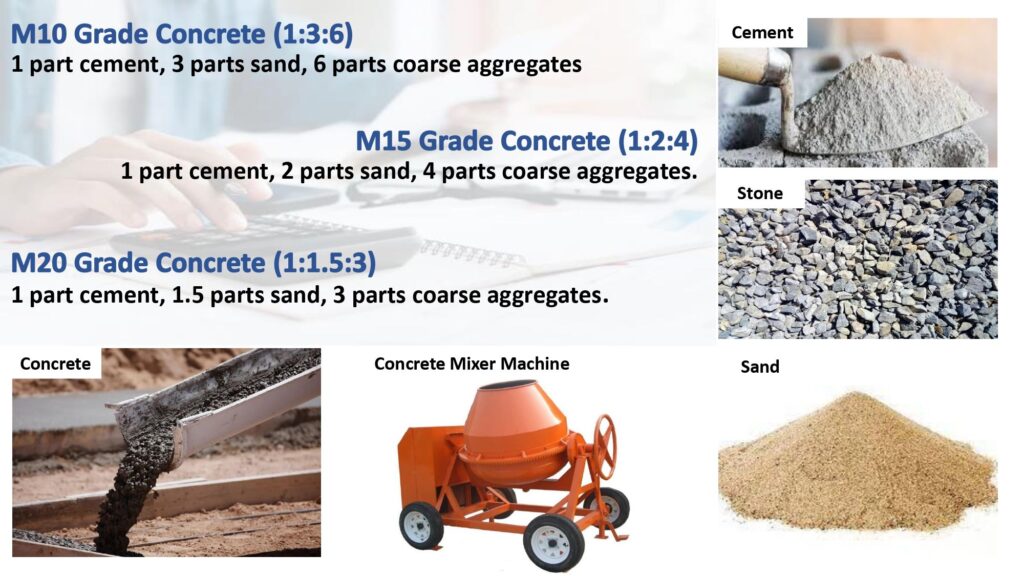
Concrete mix ratios are expressed in terms of cement : sand : aggregate. For example, a commonly used mix ratio is 1:2:4, meaning:
- 1 part cement
- 2 parts sand
- 4 parts aggregate
This ratio is typical for general-purpose concrete and yields good strength for structural applications.
Step 2: Calculate the Total Volume of Concrete Required
First, measure the total volume of concrete you need for your project. Volume is usually calculated in cubic meters (m³) or cubic feet (ft³).
Formula for volume:
- For a rectangular slab:
Volume = length × width × thickness - For other shapes, use appropriate geometric formulas.
Let’s say you need 1 cubic meter (m³) of concrete.
Step 3: Account for Dry Volume
Concrete volume in the mix is considered in its wet state, but after mixing and drying, there is some volume loss due to air voids and water evaporation. To compensate, we calculate the dry volume by multiplying the wet volume by a factor, typically 1.54.
Dry volume = Wet volume × 1.54
Example:
Dry volume = 1 × 1.54 = 1.54 m³
Step 4: Calculate the Total Parts of Mix
Add the parts of the mix ratio. For 1:2:4:
Total parts = 1 + 2 + 4 = 7 parts
Step 5: Calculate the Quantity of Cement, Sand, and Aggregate
Cement Quantity
- Cement quantity (in m³) = (Cement part / total parts) × dry volume
- Cement density ≈ 1440 kg/m³ (varies slightly)
Example:
Cement volume = (1/7) × 1.54 = 0.22 m³
Cement weight = 0.22 × 1440 = 316.8 kg
Since cement is usually sold in bags of 50 kg:
Number of bags = 316.8 / 50 ≈ 6.34 bags
Sand Quantity
Sand volume = (2/7) × 1.54 = 0.44 m³
Aggregate Quantity
Aggregate volume = (4/7) × 1.54 = 0.88 m³
Step 6: Convert Volumes to Weights (Optional)
If you want to convert sand and aggregate volumes to weights:
- Sand density ≈ 1600 kg/m³
- Aggregate density ≈ 1450 kg/m³
Example:
- Sand weight = 0.44 × 1600 = 704 kg
- Aggregate weight = 0.88 × 1450 = 1276 kg
Summary Table
| Material | Volume (m³) | Weight (kg) | Bags (Cement only) |
|---|---|---|---|
| Cement | 0.22 | 316.8 | 6.34 |
| Sand | 0.44 | 704 | – |
| Aggregate | 0.88 | 1276 | – |
Tips for Accurate Calculation
- Always measure the exact volume of your project.
- Use correct mix ratios based on your project requirements.
- Adjust water quantity according to workability and strength needs.
- Consider wastage of materials (usually 5-10%) and add accordingly.
- Use weighing scales for accurate measurement of materials.
- For large projects, consult a structural engineer for mix design.
Conclusion
Calculating the right quantities of cement, sand, and aggregate is crucial to producing strong and durable concrete. By following the steps outlined above—understanding mix ratios, calculating dry volume, and determining material quantities—you can confidently prepare concrete mixes tailored to your project needs.

Remember, practice makes perfect. With experience, you will develop an intuition for mixing concrete efficiently and effectively. Happy building!