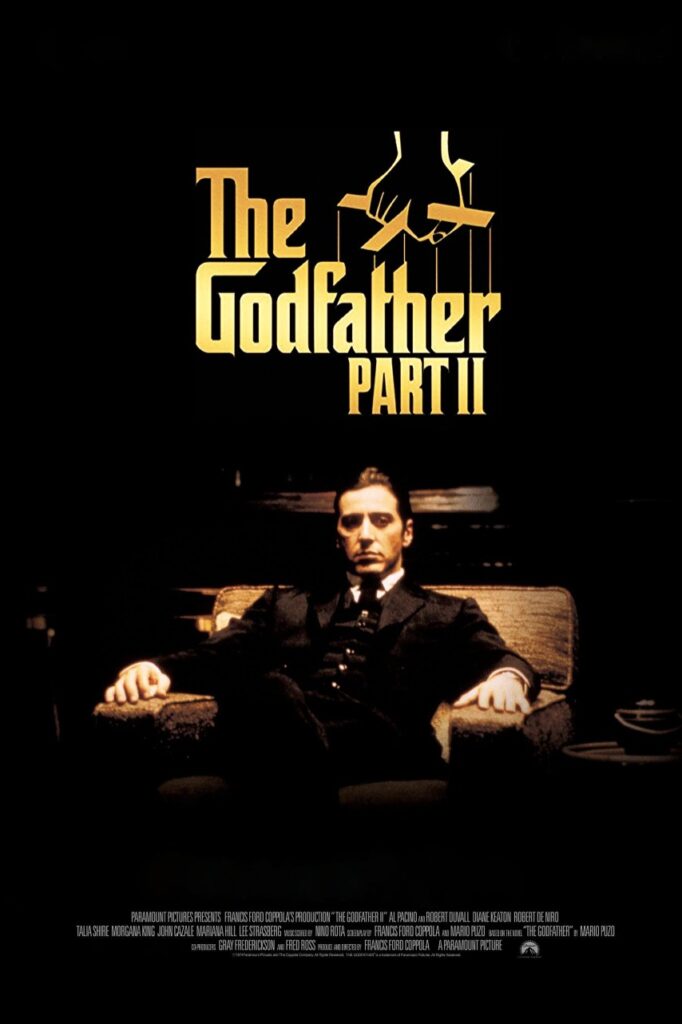
Dive into our deep-dive The Godfather Part II review. Discover why Coppola’s masterpiece on power, family, and tragedy outperforms its predecessor and remains a timeless classic.
Introduction: The Impossible Act to Follow
In the pantheon of American cinema, few phrases incite as much debate as “the greatest sequel ever made.” While Aliens, Terminator 2, and The Empire Strikes Back have their ardent defenders, one film sits atop the throne, unchallenged by critics and fans alike: Francis Ford Coppola’s The Godfather Part II.
Released in 1974, just two years after the original shattered box office records and cultural barriers, The Godfather Part II faced an impossible task. How do you continue the story of the Corleone family without the charismatic original lead, Marlon Brando (Vito Corleone), and after a definitive, door-slamming conclusion?
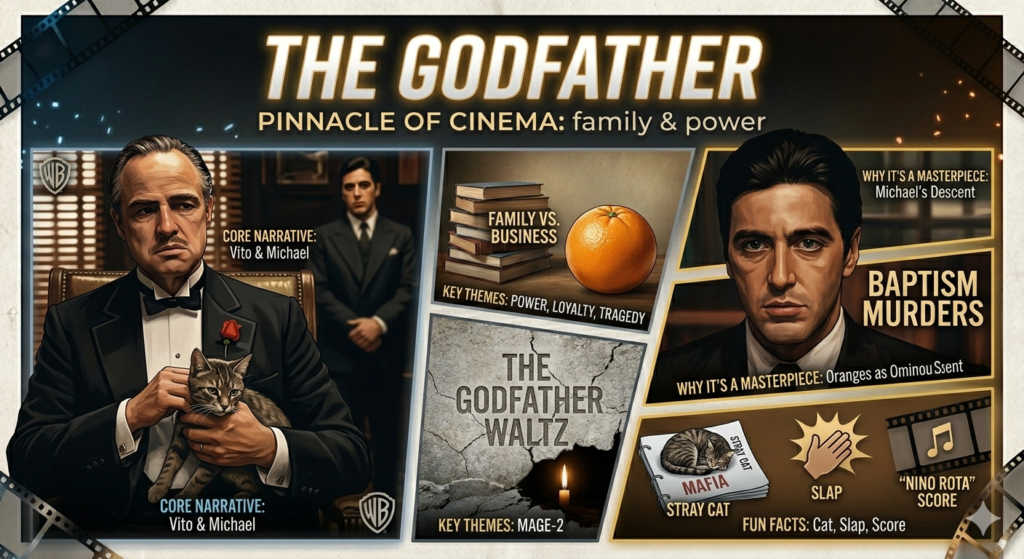
The answer was not to try. Instead, Coppola and author Mario Puzo rewrote the rules of storytelling. They delivered a 200-minute operatic tragedy that moves backward and forward in time, juxtaposing the rise of a benevolent father with the moral collapse of his son.
In this The Godfather Part II review, we will dissect why this film isn’t just a great sequel—it is arguably a superior work of art to the 1972 original.
The Dual Narrative Structure: Vito vs. Michael
What immediately sets The Godfather Part II apart is its audacious structure. The film intercuts two parallel timelines.
The Past (1901–1920s): We follow young Vito Andolini (Robert De Niro) as he escapes a Sicilian vendetta, arrives at Ellis Island, and scrapes a living in Little Italy. We watch the kind-hearted yet shrewd immigrant transform into the feared “Don” by killing the local Black Hand extortionist, Don Fanucci. This is a story of survival and community.
The Present (1958–1959): We follow Michael Corleone (Al Pacino), now the Don of the family. He has moved the empire to Lake Tahoe, Nevada. He is cold, calculating, and utterly alone. This is a story of expansion and paranoia.
The genius of this The Godfather Part II analysis is the mirror Coppola holds up. Vito builds an empire to protect his family. Michael destroys his family to protect the empire.
Al Pacino’s Terrifying Transformation
While Marlon Brando’s Vito was warm and paternal, Al Pacino’s Michael in Part II is a reptile. It is one of the most chilling performances ever committed to film.
At the start of the film, Michael is trying to go legit. He is testifying before a Senate committee about organized crime, wearing a sharp suit, hiding his hand tremor. But by the end of the first hour, we see the mask slip.
Consider the scene where Michael confronts his traitorous brother, Fredo (John Cazale). “I know it was you, Fredo,” Michael whispers. “You broke my heart.” There is no yelling. No screaming. Just the quiet, dead-eyed certainty of a man who has already signed his brother’s death warrant. Pacino plays Michael not as a villain, but as a tragic robot—a man who has killed his own humanity to win a war nobody else wanted to fight.
For anyone writing a movie review focused on acting benchmarks, Pacino’s performance here is the gold standard. He lost the Oscar that year to Art Carney (Harry and Tonto), a decision that ranks as one of the Academy’s greatest snubs.
Robert De Niro: The Silent Titan
It is impossible to discuss The Godfather Part II without acknowledging the miracle of Robert De Niro. Taking over the role of young Vito—a role made iconic by Brando—is a career suicide mission. Yet De Niro does not imitate Brando; he inherits the ghost.
De Niro learned Sicilian dialect phonetically. He gained weight. He watches the neighborhood thug with a quiet, predatory stillness. The pivotal sequence where he stalks Don Fanucci on the rooftop during a festa, then executes him in a hallway, is a masterclass in silent acting. With no dialogue, De Niro communicates vengeance, fear, and the birth of a legend.
He won the Academy Award for Best Supporting Actor, making The Godfather Part II the first sequel to win the Best Picture Oscar and the only film where two different actors (Brando and De Niro) have won Oscars for playing the same character.
Cinematography and the Tragedy of Light
Gordon Willis, the “Prince of Darkness,” returned as cinematographer. Where The Godfather used shadow to hide Brando’s face, Part II uses shadow to engulf Michael’s soul.
Look at the final flashback scene. The entire family is gathered for Vito’s birthday in 1941. The room is warm, golden, and full of life. Sonny is joking. Tom is advising. Michael sits alone, telling everyone he has enlisted in the Marines—his first act of rebellion against the family’s plans for him.
Cut to the present: Michael sits alone in the dark at Lake Tahoe. Everyone is gone. Kay has aborted his child. Fredo will soon be executed. The light has gone out of the world.
Willis’s frame tells the story better than the script does: You are watching the death of a soul.
The Tragedy of Fredo and Kay
The supporting cast in this film is flawless, but two figures stand out as the “victims” of Michael’s rise.
John Cazale as Fredo: Fredo is the incompetent, jealous middle brother. He betrays Michael to the Hyman Roth gang for respect and a few dollars. Cazale plays him not as a villain, but as a pathetic man drowning in insecurity. The kiss of death Michael gives Fredo at the Havana New Year’s party is the coldest romantic gesture in film history.
Diane Keaton as Kay: The original film sidelined Kay, but Part II weaponizes her. In the devastating abortion confession scene, Kay reveals she lost the baby on purpose. “It was an abortion, Michael… because I wouldn’t bring another one of your sons into this world.” It is the only time Pacino flinches. He slaps her across the face, but she has already won the moral argument. She escapes. He is left in hell.
The Final Shot: The Loneliest Don
Most The Godfather Part II reviews focus on the action—the Havana assassination attempt, the Senate hearings, the killing of Roth. But the film’s power lies in its silence.
The final sequence is a reverse montage: Fredo is executed by rifle shot on the lake. Then, we flash to the family dinner in 1941. Everyone is there. Michael is the only one not celebrating. As the door closes on the past, Michael is left sitting alone outside the house in the present.
He has won. He has no enemies left.
He has no friends. He has no family.
He is the Don. And he is empty.
Why You Should Rewatch It Today
If you are looking for a “fun” mob movie, watch Goodfellas. If you want a “cool” gangster film, watch Scarface.
You watch The Godfather Part II to remember that absolute power doesn’t just corrupt—it isolates. It is a Shakespearean tragedy set in Las Vegas boardrooms and Havana hotel rooms. It is a meditation on immigration, capitalism, and the American Dream turned nightmare.
Unlike modern franchises that rely on CGI explosions and post-credits scenes, Part II relies on dialogue, eyes, and the fear of silence.
Final Verdict (⭐⭐⭐⭐⭐)
- Rating: 10/10
- Best Performance: Al Pacino (Michael) & Robert De Niro (Vito)
- Best Scene: The “I know it was you, Fredo” talk.
- Who should watch it? Any aspiring filmmaker, any student of writing, or anyone who believes cinema can be high art.
Conclusion of this The Godfather Part II review: It is not just a sequel. It is a correction. It takes the themes of the original and deepens them into a sorrowful epic about the cost of winning. Forty-nine years later, nothing has come close to touching it.
(FAQ)
Is The Godfather Part II better than The Godfather?
Many critics argue yes. While the original has a tighter narrative and Brando’s charisma, Part II has greater thematic depth and a more complex structure.
Do I need to watch The Godfather before Part II?
Absolutely. Part II begins immediately after the events of the first film. Without watching the original, you will miss the emotional weight of Michael’s downfall.
What is the famous line from The Godfather Part II?
The most quoted line is Michael’s accusation: “I know it was you, Fredo. You broke my heart.”
Why did Robert De Niro win an Oscar?
For his wordless, physical transformation into young Vito Corleone, perfectly mimicking Brando’s mannerisms without copying them.
Call to Action (CTA):
Have you seen The Godfather Part II lately? Does it hold up as the best sequel of all time? Share your thoughts in the comments below, and check out our reviews of The Godfather and The Godfather Part III to complete the trilogy.