A foundation is a crucial part of any building or structure. It is the lowest load-bearing part, usually below ground level, that transfers the weight of the structure to the soil or rock beneath. Without a strong foundation, a building can suffer from uneven settling, cracking, or even collapse. Understanding what a foundation is, its types, and the basics of foundation design is essential for anyone involved in construction or civil engineering.

What Is a Foundation?
In simple terms, a foundation is the structural element that supports and anchors a building. It distributes the load of the structure evenly to the ground, ensuring stability and durability. Foundations prevent the building from shifting due to soil movement, weather conditions, or other external forces.

The primary functions of a foundation include:
- Supporting the weight of the entire structure.
- Distributing the load evenly to avoid excessive stress on the soil.
- Resisting natural forces like wind, earthquakes, and soil pressure.
- Providing a level base for construction.
Types of Foundations
Foundations are broadly classified into two main categories based on their depth and the soil conditions:
1. Shallow Foundations
Shallow foundations are placed near the surface of the ground, usually within a depth less than the width of the foundation. They are suitable for soils with good bearing capacity close to the surface.
Types of Shallow Foundations:
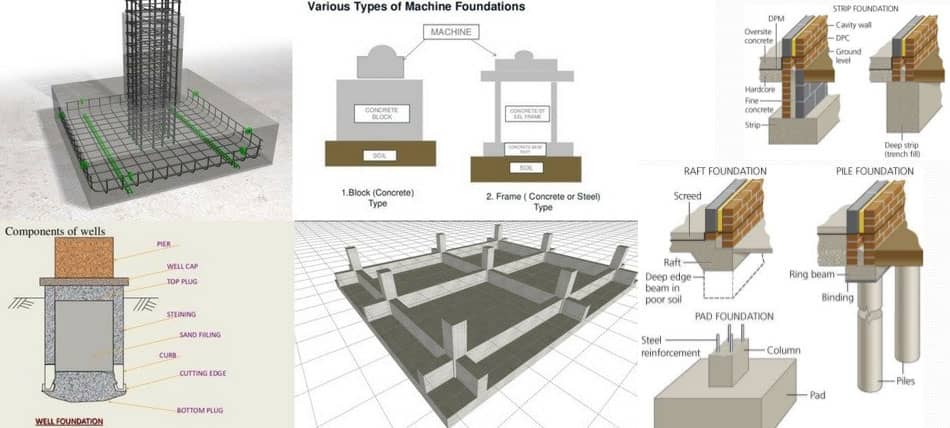
- Strip Foundation: A continuous strip of concrete that supports load-bearing walls.
- Spread Footing: Individual pads or footings spread out to distribute the load from columns.
- Mat (Raft) Foundation: A large slab that supports the entire building, used when soil bearing capacity is low or loads are heavy.
- Pad Foundation: Isolated footings for individual columns or piers.
2. Deep Foundations
Deep foundations are used when shallow foundations cannot safely support the structure due to poor soil conditions near the surface. These foundations transfer the load to deeper, more stable soil or rock layers.
Types of Deep Foundations:
- Pile Foundation: Long, slender columns made from wood, concrete, or steel driven deep into the ground.
- Caisson Foundation: Large-diameter concrete shafts sunk into the ground to reach bedrock or firm soil.
- Pier Foundation: Similar to piles but typically larger in diameter and constructed by drilling.
Design Basics of Foundations
Designing a foundation involves several critical considerations to ensure safety, durability, and cost-effectiveness:
1. Soil Investigation
Understanding soil properties is fundamental. Engineers conduct soil tests (like borehole sampling, Standard Penetration Test) to determine soil type, bearing capacity, moisture content, and settlement characteristics.
2. Load Assessment
Calculating the total load from the building including dead loads (structure weight), live loads (occupants, furniture), and environmental loads (wind, seismic) is essential to design a foundation that can safely support these forces.
3. Selection of Foundation Type
Based on soil data and load requirements, the appropriate foundation type is chosen. Shallow foundations are preferred for firm soils and light to moderate loads, while deep foundations are necessary for weak soils or heavy loads.
4. Depth and Size
The depth of the foundation must be adequate to prevent frost action, soil erosion, or other environmental effects. The size must be sufficient to distribute the load without exceeding soil bearing capacity.
5. Materials
Common materials include concrete, steel reinforcement, masonry, and timber. Concrete is the most widely used due to its strength and durability.
6. Drainage and Waterproofing
Proper drainage is necessary to prevent water accumulation around foundations which can weaken the soil and cause damage. Waterproofing measures protect the foundation from moisture.
7. Compliance with Codes
Foundation design must comply with local building codes and standards to ensure safety and legality.
Conclusion
A solid foundation is the backbone of any construction project. Understanding the different types of foundations and the basics of their design helps in creating stable, safe, and long-lasting structures. Whether you are a homeowner, builder, or engineering student, familiarizing yourself with foundation concepts is invaluable for successful construction outcomes.
For more detailed guidance on foundation design, consult with a structural engineer or refer to building codes relevant to your region.