Confused by foundation depth? Our simple guide breaks down how to calculate foundation depth based on soil, climate, and load. Learn the rules of thumb and when to call a pro.
Foundation Depth Calculation Made Simple: No Engineering Degree Required
The foundation is the unsung hero of any structure. It’s the critical link between your building and the earth, silently bearing the load for decades. Get it right, and no one will ever notice. Get it wrong, and you’ll face cracks, uneven floors, and even structural failure.
Calculating foundation depth might seem like a job for a seasoned engineer (and for complex projects, it is!), but the core principles are surprisingly straightforward. This guide will demystify the process, giving you the knowledge to understand why a foundation is dug to a certain depth and the confidence to discuss your project intelligently with professionals.
The #1 Rule: It’s Not Just About the Building, It’s About the Ground
The most important concept to grasp is that foundation depth is determined more by what’s below the ground than what’s above it. A lightweight shed needs a different foundation than a two-story house, but both are profoundly affected by the soil they sit on.
The Three Key Factors That Dictate Foundation Depth
Think of these as the three pillars of foundation design:
1. Frost Line (Frost Depth) – The Non-Negotiable Minimum
This is the single most important factor for anyone building in a climate that experiences freezing temperatures.
- What it is: The frost line is the deepest depth to which the ground will freeze in winter.
- Why it matters: When water in the soil freezes, it expands. If your foundation footing (the wide base at the bottom) is above this line, the expanding frozen soil can push it upwards. When the ground thaws, it settles back down. This annual cycle, called frost heave, can crack and destroy your foundation.
- The Rule: The bottom of your foundation footing must always extend below the frost line. This ensures it rests on stable, unfrozen soil that won’t shift seasonally.
How to find it: Your local building department will have a code specifying the frost line depth for your area. This is not a suggestion—it’s a legal requirement.
2. Soil Bearing Capacity & Type – The “Strength” of the Ground
Not all soil is created equal. You need to know if you’re building on solid rock or soft clay.
- What it is: Bearing capacity is the soil’s ability to support the load placed on it without failing or settling excessively. It’s measured in pounds per square foot (psf).
- Why it matters: Weak soil (like soft clay or loose fill) requires a wider foundation to spread the building’s load over a larger area. Sometimes, you need to dig down to a deeper, stronger soil layer.
- The Rule: A site’s soil type directly influences the size and type of foundation, which in turn can affect its depth.
| Soil Type | Approx. Bearing Capacity | Implication for Depth |
|---|---|---|
| Bedrock | 4,000+ psf | Excellent. Minimal depth needed, just below frost line. |
| Sand/Gravel | 2,000 – 3,000 psf | Good. Standard footings work well. Depth set by frost line. |
| Stiff Clay | 1,500 – 2,000 psf | Fair. May require deeper, wider footings. |
| Soft Clay/Silt | < 1,000 psf | Poor. Often requires deep foundations (piles/piers). |
How to check it: A simple percolation test or even digging a test pit can give you a good idea. For larger projects, a geotechnical engineer will perform a soil investigation and provide a formal report.
3. Structural Load – The “Weight” of the Building
This is the factor most people think of first: how heavy is the structure?
- What it is: The total weight of the building, including its own structure, occupants, furniture, and snow on the roof.
- Why it matters: A heavier load exerts more pressure on the soil. To compensate, the foundation needs to be wider or deeper to transfer that load to a soil layer that can handle it.
- The Rule: Heavier buildings (e.g., two-story with brick veneer) need larger footings than lighter ones (e.g., a single-story wood-frame house).
A Simplified “Rules of Thumb” Calculation
While a full calculation requires an engineer, you can estimate a starting point for a simple project like a shed or deck.
For a basic, stable soil and a cold climate:
- Start with Frost Depth: Let’s say your local frost line is 36 inches.
- Add Footing Height: A typical concrete footing is 8 inches thick.
- Add Foundation Wall Depth (if applicable): The foundation wall will sit on the footing. For a shallow foundation, the wall might be 24 inches deep.
Estimated Foundation Depth (to bottom of footing): 36 inches.
This is a simplified example, but it shows the logic: the frost line sets the minimum, and the foundation components are built down to that level.
Foundation Types and Their Typical Depths
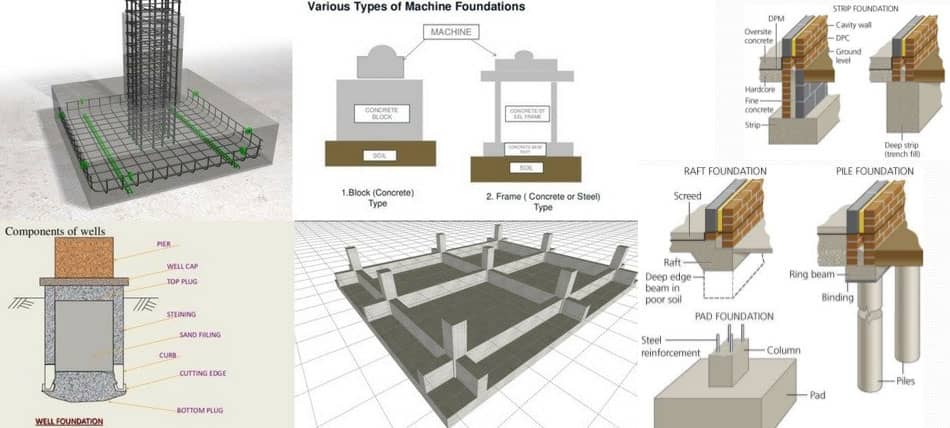
- Shallow Foundations (Spread Footings):
- Used for: Most houses, garages, and small buildings on stable soil.
- Depth: Typically 3 to 5 feet, primarily determined by the frost line.
- Deep Foundations (Piles & Piers):
- Used for: Heavy buildings, weak soil, or areas with high water tables.
- Depth: Can be 20 feet or more, extending down until they hit a suitable bearing layer like bedrock.
When to Absolutely Call a Professional
This guide is for educational purposes. You must hire a structural or geotechnical engineer if:
- You are building anything other than a small shed, deck, or patio.
- Your soil is soft, sandy, or has a high clay content.
- You are building on a slope.
- There are trees nearby (their roots affect soil moisture).
- You are in a seismic or high-wind zone.
- You are unsure about any of the factors above.
An engineer’s fee is a small price to pay for the absolute certainty that your home’s foundation is safe and sound.
Referrals for Further Reading
- International Residential Code (IRC) – Chapter 4: Foundations
- What it is: The code that most local building departments adopt. It contains tables for footing sizes based on soil type and load.
- Best for: Understanding the legal requirements and standard practices.
- “The Foundation Engineering Handbook” by Hsai-Yang Fang
- What it is: A comprehensive, if technical, resource for deep understanding.
- Best for: Engineers, architects, and very serious DIYers who want the full theory.
- National Ready Mixed Concrete Association (NRMCA) Website
- What it is: An industry resource with many public-facing articles on residential concrete and foundations.
- Best for: Practical tips on concrete mix design and placement for foundations.
Conclusion: Build Your Knowledge First
Calculating foundation depth isn’t a single mathematical equation; it’s a process of evaluating site-specific conditions. By understanding the critical roles of the frost line, soil type, and structural load, you move from guessing to informed reasoning.
Remember, the goal is to transfer the building’s load to a stable, undisturbed layer of earth, safely below the reach of frost and environmental changes. Use this knowledge as your foundation for planning, and never hesitate to invest in expert advice for the structure that will support everything else.