Our in-depth Schindler’s List review explores why Spielberg’s black-and-white epic remains the most essential Holocaust film ever made. A heartbreaking meditation on evil, redemption, and the price of a single life.
Introduction: The Film That Should Not Have Worked
In 1993, Steven Spielberg was the undisputed king of blockbuster entertainment. He gave us the shark, the alien, the dinosaurs, and Indiana Jones. He made us cheer, laugh, and hide behind our popcorn. He was not the director you expected to make the definitive film about the Holocaust.
Then came Schindler’s List .
Three hours and fifteen minutes. Black and white. No special effects. No heroes with guns. No happy endings. By every logical measure, it should have been a commercial disaster—an important film that nobody wanted to watch twice.
Instead, it became one of the most honored and influential films in cinema history. Seven Academy Awards, including Best Picture and Best Director. A rare perfect score on Rotten Tomatoes. And, most importantly, a permanent place in the global conscience.
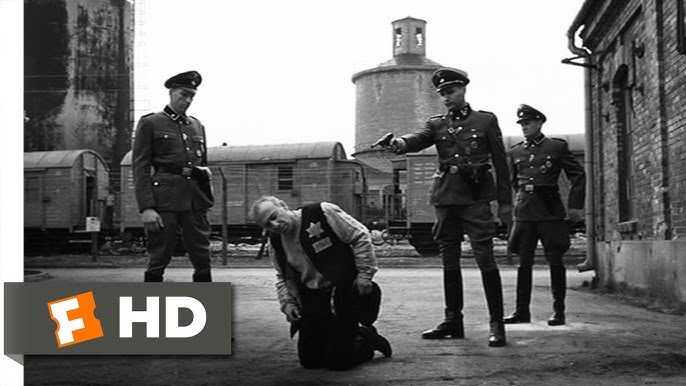
In this Schindler’s List review , we will examine how Spielberg transformed the true story of Oskar Schindler into a cinematic testament to horror, humanity, and the impossible possibility of redemption.
The True Story: An Unlikely Savior
Oskar Schindler (Liam Neeson) was not a hero. This is the film’s first and most important truth.
A Nazi Party member. A womanizer. A war profiteer. Schindler arrived in Kraków, Poland, in 1939 looking to get rich off the German invasion. He bribed SS officers, exploited Jewish labor, and ran a factory manufacturing enamelware for the German army. He was, by any moral accounting, a villain.
And then something changed.
We cannot pinpoint the exact moment. Perhaps it was watching the liquidation of the Kraków Ghetto. Perhaps it was the little girl in the red coat. Perhaps it was simply the accumulation of horror, day after day, until his greed could no longer drown out his conscience.
By the end of the war, Schindler had spent his entire fortune bribing Nazi officials to save the lives of over 1,200 Jews. He shielded them from Auschwitz. He fed them when the Reich starved them. He wept at the end, not for his lost money, but because he could have saved more.
“I could have got one more person… and I didn’t.”
That is what makes Schindler’s List so devastating. It is not about a saint who descended from heaven to save the innocent. It is about a deeply flawed human being who, confronted with absolute evil, decided to do something. It suggests that redemption is possible—but only if we are willing to pay for it.
The Horror: Depicting the Undepictable
How do you film the Holocaust? How do you show the unspeakable without exploiting it? This was Spielberg’s impossible task. Too graphic, and the film becomes pornography of suffering. Too gentle, and it becomes a betrayal of the dead.
Spielberg’s answer was to film everything through the lens of witness. The camera does not flinch, but it does not leer.
Consider the Kraków Ghetto liquidation scene. For twenty minutes, we follow a single Jewish family as the SS destroys their home, murders their elderly, and shoots a woman in the street. A young boy runs through the carnage, dodging bullets, hiding in toilets, climbing over bodies. We see everything. The children killed. The old woman asked, “Is that a chicken you’re hiding?” —only to reveal a baby, smothered to silence.
It is unbearable. It is supposed to be.
Spielberg uses documentary techniques: handheld cameras, long takes, available light. The black-and-white cinematography (by Janusz Kamiński) strips away any romanticism. This is not a war movie. This is not an adventure. This is a record of industrial murder.
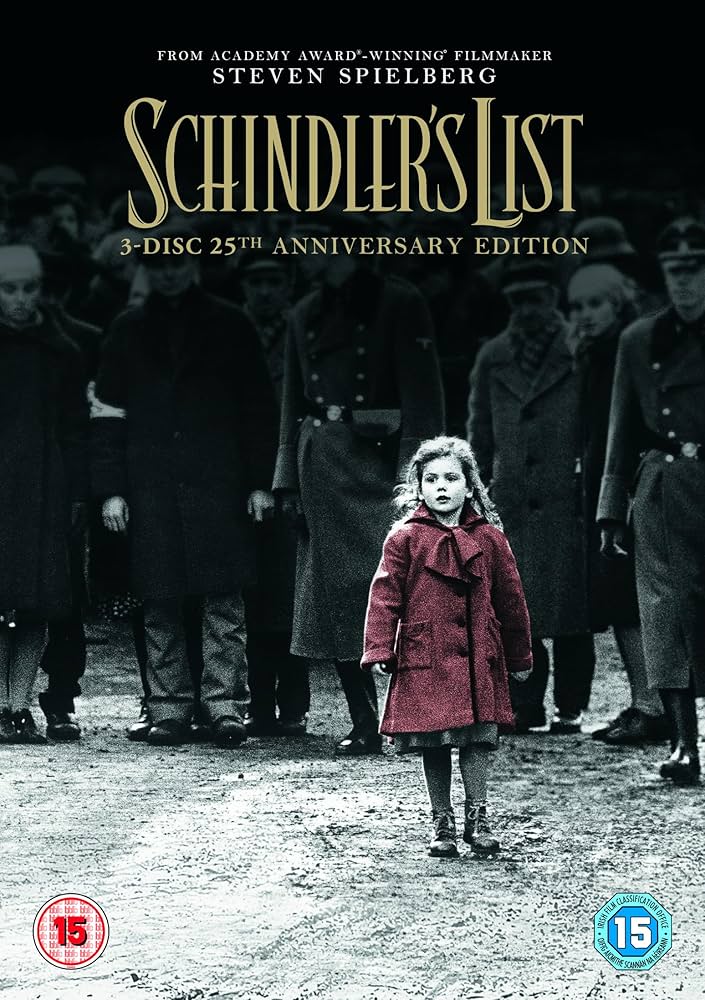
And then there is the girl in the red coat. The only color in the film. A tiny splash of crimson as a child walks through the chaos, oblivious, before disappearing into a tenement. Later, Schindler sees her body on a cart, pale and lifeless. The red coat is still visible, now a stain against white ash.
Spielberg has said that the red coat represents the innocence of the victims—and the limitations of black-and-white morality. The world is not simply good or evil. There are shades of red.
The Performances: Three Flawless Portraits
Schindler’s List lives or dies on its central performances. Spielberg cast perfectly, and his three leads delivered career-defining work.
Liam Neeson as Oskar Schindler: Before this film, Neeson was a respected but not iconic actor. His Schindler is a revelation—charming, calculating, morally empty, and then, gradually, achingly human. Watch his face during the liquidation scene. He stands on a hillside, riding a horse, watching the horror unfold from above. He does nothing. He says nothing. But his eyes tell us everything: he is watching himself watch, and he is disgusted. Neeson transforms before our eyes from a profiteer into a penitent.
Ben Kingsley as Itzhak Stern: The conscience of the film. Stern is Schindler’s Jewish accountant, a man who sees through the Nazi’s charm from the beginning. Kingsley plays him as weary, intelligent, and quietly defiant. When Schindler toasts the SS at a party, Stern looks away—not in judgment, but in calculation. He knows the game. He plays it to save lives. It is a performance of extraordinary restraint.
Ralph Fiennes as Amon Goeth: The most terrifying performance in cinema history. Fiennes plays the real-life commandant of the Plaszów labor camp as a study in casual evil. Goeth shoots prisoners from his balcony for target practice. He beats his maid for no reason. He struggles to forgive himself for not killing a boy, then shoots him anyway. Fiennes is not a monster. He is a man who has decided to be one. That is infinitely more frightening.
The scene where Goeth tries to learn forgiveness from Schindler is the film’s moral core. Schindler tells him that “power is when we have every justification to kill, and we don’t.” Goeth tries. He stares at a boy who has failed to clean a bathtub. He looks at his reflection. He says, “I pardon you.”
Then, the next morning, he shoots the boy anyway.
Forgiveness is a muscle Goeth cannot flex. And that, the film suggests, is the difference between him and Schindler.
Cinematography and Sound: The Language of Memory
Janusz Kamiński’s black-and-white cinematography deserves its own analysis. He shot the film with a muted, high-contrast palette that mimics documentary footage from the 1940s but also evokes the texture of memory. The whites are blown out; the blacks are absolute. Faces emerge from shadow like ghosts.
Kamiński used no filters. The black-and-white effect comes entirely from lighting, production design, and costume. The result is stark, immediate, and timeless.
And then there is John Williams’s score. The greatest living film composer wrote something he did not want to write. He told Spielberg, “This film needs a more accomplished composer than me.” Spielberg replied, “I know. But they’re all dead.”
Williams composed a minimalist, mournful theme for violin—played by Itzhak Perlman. It is not heroic music. It is not sad music, exactly. It is the sound of memory aching to forget.
The final sequence—when the surviving Schindler Jews place stones on his grave in Jerusalem—is scored with silence, then a swelling chorus. It is the only moment of musical triumph in the entire film. We have earned it.
The Ending: 1,100 Lives, and a Rock on a Grave
The final act of Schindler’s List is famously devastating. After the war ends, Schindler stands before his factory workers, now free, and breaks down.
“I could have got more.”
He counts his car. Ten more lives. His gold Nazi pin. Two more lives. He tears at his lapel, sobbing, pointing to his ring. One more. Always one more.
“I didn’t do enough.”
Itzhak Stern takes his hands. He says, “There will be generations because of what you did.”
And then the film delivers its most powerful image. The survivors, one by one, place stones on Schindler’s grave. Real survivors. The actual people Schindler saved. Their children. Their grandchildren.
The black-and-white fades to color. We are no longer watching a recreation. We are watching history. The people on screen are alive because one man decided not to be a Nazi anymore.
The film ends not with despair, but with impossible, fragile, necessary hope.
Final Verdict: Essential. Devastating. Unforgettable.
Rating: ★★★★★ (10/10)
Best Performance: Ralph Fiennes (Amon Goeth) — a portrait of evil so convincing that Holocaust survivors trembled when they met him on set.
Best Scene: The girl in the red coat, twice seen—first walking, then dead.
Best Line: “Whoever saves one life saves the world entire.”
Who Should Watch It: Everyone. But be prepared. This is not entertainment. This is witness.
Warnings: Extreme violence, child death, nudity in non-sexual contexts, psychological devastation. Not for children under 16.
Conclusion
Schindler’s List review essays often struggle to find new words for a film that has been discussed for three decades. But the truth is simple: this is the most important Holocaust film ever made, and perhaps the most important historical drama in American cinema.
Spielberg did something remarkable. He took the worst crime in human history and made a film that is not about despair, but about the difference one person can make. He showed us evil unflinching—and then showed us that decency, however late and imperfect, is still worth choosing.
By the end of the film, Schindler has lost everything. He is bankrupt. His marriage is destroyed. He flees the Allies as a Nazi Party member. But he has 1,200 reasons to live.
We have one film to remember them by.
Frequently Asked Questions (FAQ)
Is Schindler’s List historically accurate?
Yes, within the limits of dramatic adaptation. Oskar Schindler did save over 1,200 Jews. The major events—the liquidation of the Kraków Ghetto, the Plaszów camp, the move to Brünnlitz—are accurate. Some characters and conversations are composites or inventions.
Why is Schindler’s List in black and white?
Spielberg chose black and white to evoke documentary footage from the 1940s and to remove any aesthetic pleasure from the violence. The only color is the girl’s red coat, which symbolizes innocence and the limitations of moral binaries.
Is Schindler’s List appropriate for students?
The film is rated R and is intensely graphic. Most educators recommend it for ages 16 and up, with preparation and discussion. It is frequently shown in high school Holocaust education units.
How accurate is Ralph Fiennes’s Amon Goeth?
Frighteningly accurate. Goeth was indeed a sadistic killer who shot prisoners from his balcony. Survivors who visited the set told Spielberg that Fiennes’s resemblance to the real Goeth gave them nightmares.
Where were the real Schindler Jews buried?
Oskar Schindler requested burial in Jerusalem. His grave is on Mount Zion, and it is covered in stones left by visitors—a Jewish tradition for honoring the dead.
Call to Action (CTA)
Have you seen Schindler’s List? How did it change your understanding of the Holocaust? Share your reflections in the comments below—but please be respectful. This film memorializes real people. And if you haven’t seen it yet, set aside three hours when you can watch without distraction. Bring tissues. Bring courage.