Our spoiler-free The Lord of the Rings: The Return of the King review explores why Peter Jackson’s 11-Oscar masterpiece remains the gold standard for epic fantasy, emotional payoffs, and triumphant storytelling.
Introduction: The Weight of an Ending
Few challenges in filmmaking are as daunting as concluding a beloved trilogy. For every Star Wars or Matrix, there is a finale that stumbles, leaving audiences disappointed and franchises tarnished. When Peter Jackson embarked on The Lord of the Rings: The Return of the King, he carried the hopes of millions of book lovers and moviegoers who had already fallen in love with The Fellowship of the Ring and The Two Towers.
The question hanging over the 2003 release was simple but terrifying: Could he stick the landing?
The answer arrived like the charge of the Rohirrim at dawn—thunderous, tearful, and absolutely triumphant. The Lord of the Rings: The Return of the King is not merely a great sequel or a great fantasy film. It is, by many measures, the greatest Best Picture winner in Oscar history and the definitive ending to the most ambitious cinematic achievement of the 21st century.
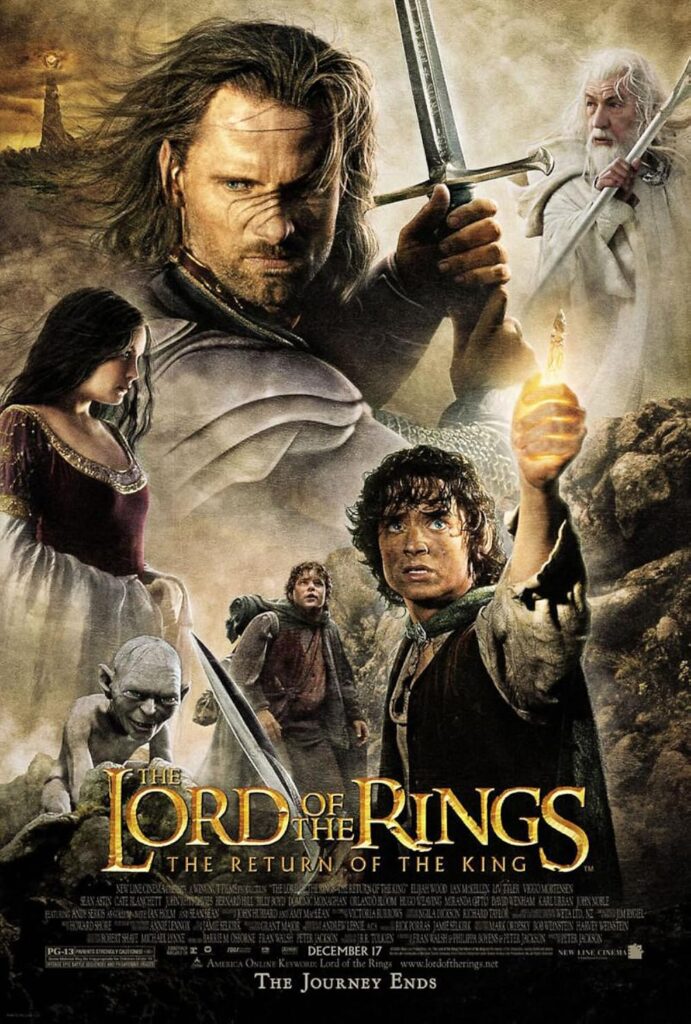
In this The Lord of the Rings: The Return of the King review , we will examine how Jackson transformed J.R.R. Tolkien’s densest volume into a visceral, emotional, and spiritually profound masterpiece—and why it remains unmatched 20 years later.
The Setup: Everything Comes Down to This
The Return of the King picks up exactly where The Two Towers left off, with no recap, no hand-holding, and no time wasted.
The forces of darkness are assembling. Sauron’s vast armies pour from Mordor. Minas Tirith, the capital of Gondor, braces for annihilation beneath the shadow of the Dark Lord’s might. Gandalf (Ian McKellen) races to prepare the city’s steward, the mad and grieving Denethor (John Noble), for war. Meanwhile, Aragorn (Viggo Mortensen) must finally embrace his destiny as the heir to the throne of Gondor—a path that requires walking through the haunted paths of the dead.
And deep in the wasteland of Mordor, Frodo (Elijah Wood) and Sam (Sean Astin) crawl toward Mount Doom. They are starving, dehydrated, and broken. Between them and their goal stands the twisted, pitiful creature Gollum (Andy Serkis), scheming to reclaim his “Precious” by leading them into the lair of the giant spider Shelob.
Three storylines. Three converging paths. One single purpose: the destruction of the One Ring.
What makes The Return of the King extraordinary is how Jackson balances these threads. The battle sequences are operatic in scale, but the film never loses sight of the small, human (and hobbit) moments that give those battles meaning.
The Battle of Pelennor Fields: A Masterpiece of Action Cinema
Let us address the elephant—or rather, the oliphaunt—in the room. The Battle of Pelennor Fields remains, after two decades, the most spectacular battle sequence ever committed to film.
It begins with the beacons of Gondor. Those breathtaking shots of mountaintop fires igniting across the spine of Middle-earth, signaling Rohan for aid, are pure cinematic poetry. Then comes the siege: massive siege towers rolling toward Minas Tirith’s walls, the terrifying screams of the Nazgûl on winged beasts, and the impossible sight of Grond—a wolf-headed battering ram the size of a skyscraper—pounding the gates of the city to dust.
Just when all hope seems lost, we hear them. Horns. Distant at first, then swelling.
“Theoden King stands alone.”
“Not alone.”
The charge of the Rohirrim is one of those rare movie moments that transcend the screen. Six thousand horsemen, led by King Theoden (Bernard Hill), screaming “Death!” as they crash into the flank of Sauron’s horde. The cinematography, the music (Howard Shore’s absolute best), the CGI orcs, the practical horses—everything works in flawless harmony.
And then the Witch-King of Angmar, Lord of the Nazgûl, descends. No man can kill him. The prophecy is clear. But Merry and Éowyn (Miranda Otto) do not care for prophecy. Éowyn’s revelation—“I am no man” —before driving her sword through the wraith’s face is a moment of feminist triumph that still electrifies.
By the time Aragorn arrives with the Army of the Dead, you realize you have been holding your breath for twenty minutes. That is the power of great action cinema. It does not just show you violence. It makes you feel the stakes.
The Emotional Core: Frodo, Sam, and the End of Innocence
For all its epic battles and sweeping landscapes, The Return of the King is ultimately a story about two hobbits trudging through a volcanic wasteland. And that is where the film’s emotional soul resides.
Sean Astin’s Samwise Gamgee delivers what may be the greatest supporting performance in fantasy film history. He is the hero the story actually needs—loyal, stubborn, brave, and deeply, compassionately human. When Frodo collapses on the slopes of Mount Doom, unable to continue, Sam speaks the film’s thesis aloud:
“I can’t carry it for you. But I can carry you.”
He lifts Frodo onto his back. He climbs. The camera pulls back to show two tiny figures against a mountain of fire. It is absurd. It is impossible. It is the most moving image in the entire trilogy.
Frodo’s tragedy is that he succeeds—and is destroyed anyway. At the Crack of Doom, he claims the Ring for himself. He fails. He would have become a new Dark Lord. The quest only succeeds because Gollum bites off his finger and falls into the fire, destroying the Ring in his clumsy, desperate dance of triumph.
Frodo saved the world. But the wound from the Morgul blade, the sting of Shelob, and the weight of the Ring have hollowed him out. He cannot stay in the Shire. He cannot be the hobbit who left Bag End a thousand pages ago.
The film’s final twenty minutes—often criticized as “too many endings”—are essential. We need to see the coronation. We need to see Aragorn bow to the hobbits. We need to see Frodo say goodbye to Sam, Merry, and Pippin at the Grey Havens.
And we need to see Sam come home, pick up his daughter, and whisper, “Well, I’m back.”
Acting, Direction, and Visual Effects: The Perfect Storm
Let us praise the ensemble without reservation. Ian McKellen’s Gandalf the White is a study in weary authority. Andy Serkis’s Gollum is a landmark motion-capture performance—tragic, disgusting, and pitiable all at once. John Noble’s Denethor is Shakespearean madness, chewing tomatoes and watching his son burn with nihilistic glee. Bernard Hill’s Theoden gives us the greatest last words in fantasy cinema: “I go to my fathers, in whose mighty company I shall not now feel ashamed.”
Peter Jackson, working from a script co-written with Fran Walsh and Philippa Boyens, directs with impossible confidence. He knows when to linger (the lighting of the beacons) and when to cut (the black ships arriving). He trusts his audience to remember characters introduced three hours earlier in the first film. He assumes we are intelligent.
The visual effects, produced by Weta Digital, remain shockingly good. Gollum’s skin texture, the scale of the Mumakil, the realism of Shelob—none of it looks dated. That is because Jackson prioritized practical effects wherever possible and used CGI to enhance, not replace, reality.
Howard Shore’s score is the secret weapon. The Rohirrim theme, the Gondor motif, and the shattering choral climax when the Ring falls—Shore wrote music that belongs alongside John Williams and Ennio Morricone.
The Oscars: An Unprecedented Sweep
At the 76th Academy Awards, The Lord of the Rings: The Return of the King won all 11 Oscars for which it was nominated. Tied with Ben-Hur and Titanic for the most wins in history, the sweep included:
- Best Picture
- Best Director (Peter Jackson)
- Best Adapted Screenplay
- Best Original Score
- Best Original Song (“Into the West”)
- Best Visual Effects
- Best Sound Mixing
- Best Sound Editing
- Best Art Direction
- Best Costume Design
- Best Makeup
No fantasy film had ever won Best Picture before. None has since. The Academy, which historically snubs genre filmmaking, could not deny the achievement. Return of the King was not just a great fantasy film—it was a great film, period.
Final Verdict: A Flawless Conclusion
Rating: ★★★★★ (10/10)
Best Performance: Sean Astin as Samwise Gamgee (though Andy Serkis runs a close second)
Best Scene: The Charge of the Rohirrim (with Sam carrying Frodo up Mount Doom as a close runner-up)
Best Line: “I can’t carry it for you. But I can carry you.”
Who Should Watch It: Everyone. Even if you dislike fantasy, the film’s themes of friendship, sacrifice, and the cost of heroism are universal.
Warnings: Prepare to cry. Multiple times. Bring tissues.
Conclusion
The Lord of the Rings: The Return of the King review articles often focus on the battles or the Oscars. Those are important. But what makes this film endure is its heart.
Peter Jackson and his team understood something essential about Tolkien’s work: adventure changes people. You cannot go to Mordor and come back unchanged. Frodo carries his wound forever. Sam carries his memories. The Shire remains beautiful, but home feels different after you have seen the fires of Mount Doom.
The final shot of the film—the credits rolling over beautiful illustrations of the characters—is a goodbye. Jackson is saying, “The story is over. These people are fictional. But while you watched, they were real.”
Twenty years later, they still are.
Frequently Asked Questions (FAQ)
Is The Lord of the Rings: The Return of the King the best of the trilogy?
Most critics and fans rank it as the best, primarily due to its emotional payoff and spectacular battle sequences. However, some prefer the intimate fellowship of the first film or the tonal complexity of the second.
How many endings does The Return of the King have?
The film has six distinct epilogue sequences after the Ring is destroyed, including the coronation, the hobbits’ return to the Shire, and the Grey Havens departure. Jackson faithfully adapted Tolkien’s multiple farewells.
Why didn’t the movie include the Scouring of the Shire?
Peter Jackson and the writers chose to omit this book chapter because it would have added another 45 minutes to an already long film and deflated the emotional momentum after the Ring’s destruction.
Do I need to watch the extended editions?
The theatrical cut is a masterpiece. The extended edition adds roughly 50 minutes of material, including Saruman’s death and the Mouth of Sauron. For devoted fans, the extended cut is definitive. For first-time viewers, the theatrical cut is plenty.
Is The Return of the King sad?
Yes. Multiple beloved characters die. Frodo’s trauma is devastating. But the film is ultimately hopeful—a meditation on how love and friendship can overcome even the darkest darkness.
Call to Action (CTA)
Have you experienced The Lord of the Rings: The Return of the King on the big screen? Do you prefer the theatrical cut or the extended edition? Share your memories of the greatest fantasy finale ever made in the comments below. And if you haven’t watched it in a while—tonight is the night.